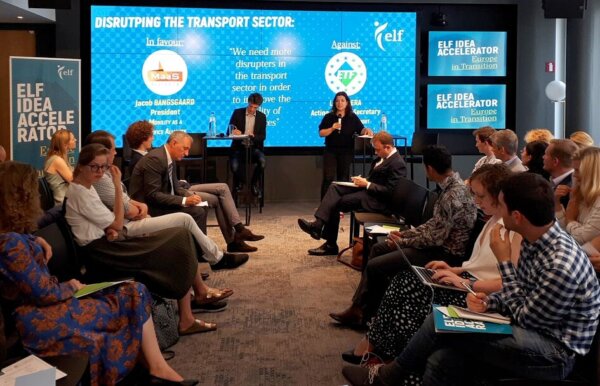
 Joining the #IdeaAccelerator at the European Liberal Forum, our Acting General Secretary argued that not all disruption in the transport sector brings a better service to users. What’s more, we cannot only think of people as consumers. If new models offload the social costs of work onto the taxpayer or force wages down to unsustainable levels, who really benefits?
In the Cambridge Union-style debate, Livia faced Jacob Bangsgaard of the Mobility as a Service Alliance, who argued that disruptive new providers in the transport sector brought greater efficiency and better service for customers. Livia, on the other hand, took a more nuanced view of the broader context. If the argument is that platforms make transport more efficient or easy-to-use for users, let’s find ways to achieve that while respecting labour rights, environmental sustainability.
Here’s some key takeaways from what Livia said:
No one is totally against change and progress, but we must take an honest look at these disruptors. Disruption and new technologies can bring improvements in transport that benefit the whole of society. When that is the case, they should be welcomed. However, we have to look beyond the glossy surface and really evaluate the impact of new providers and platforms in a holistic way. Research and regulatory challenges are beginning to reveal the real consequences of these new ways of providing transport and mobility services, and often what seems like a great new idea can have negative side-effects.
We are more than consumers. Debates on disrupters in transport are dominated by a conception of people as customers or consumers. But we must remember that we are also citizens and workers. We should not forget any of these aspects. For example, as a customer we might enjoy the chance to pay very little for a ride through the city or to fly to our holiday destination for only €5.99. But what is the impact on us as citizens and workers? If it means poorly-paid work in bad conditions, with the taxpayer cleaning up the consequences, is this really what we want? In any case, we can also doubt that these disruptors are really improving the quality of transport services much beyond a reduction in price.
Is a disruptive transport boom environmentally sustainable? A recent report about San Francisco has found that ride hailing platforms are responsible for more than 50% of the increase in San Francisco’s traffic congestion between 2010 and 2016. Congestion in San Francisco increased by 60% during this period. In the current context of climate emergency, this aspect needs to be carefully considered.
More and cheaper transport is not necessarily the best outcome. The low price of transport is the cause of most of the problems that the sector faces: environmental damage, weak profitability and collapsing social standards. Business models where platforms subcontract transport to smaller companies or individual freelancers are not economically viable, the margins they impose on their subcontractors are very small. Indeed, even the platforms themselves struggle to extract a profit: Uber has never finished a year in the black! Does all this cost-cutting result in a better trip for customers? That is not sure. Does it result in decent working conditions? Certainly not! Low cost airlines offer a good case study, and we can include them in the category of disruptors. Flights are cheaper, but the quality of service is not taken into consideration. Meanwhile workers face terrible conditions and struggle for their rights at companies like Ryanair.
Where are the savings coming from? By denying their role as direct employers, digital platforms and new business models avoid their responsibility for the social protection, health insurance, pensions, etc, of their workers. They slash wages and then offload the social costs onto individual workers and the general public. Remember – that is all of us taxpayers! So what is the advantage for us in celebrating and promoting this kind of business model? We save money as customers, but we pay the cost as workers and as citizens!
Labour rights and collective bargaining should not be abandoned. Disruptive providers built on digital platforms or complex chains of subcontracting also make it difficult for workers to exercise their fundamental human right to collective bargaining and trade union membership. Of course there is often a lack of respect for labour rights in traditional companies, but the problem with disruptors is that we often have no counterpart to discuss with at all. When we try to have a dialogue with them, we are denied. The result of this disruption in the employment relationship is that workers struggle to stand together and improve their pay and conditions. This further entrenches the negative social impact for workers and citizens.
In conclusion, we welcome new models when they really benefit us all in our roles as consumers, workers and citizens. But, for the moment, too many disruptors are just using new technologies for the old tricks to circumvent social standards.