Gender Equality
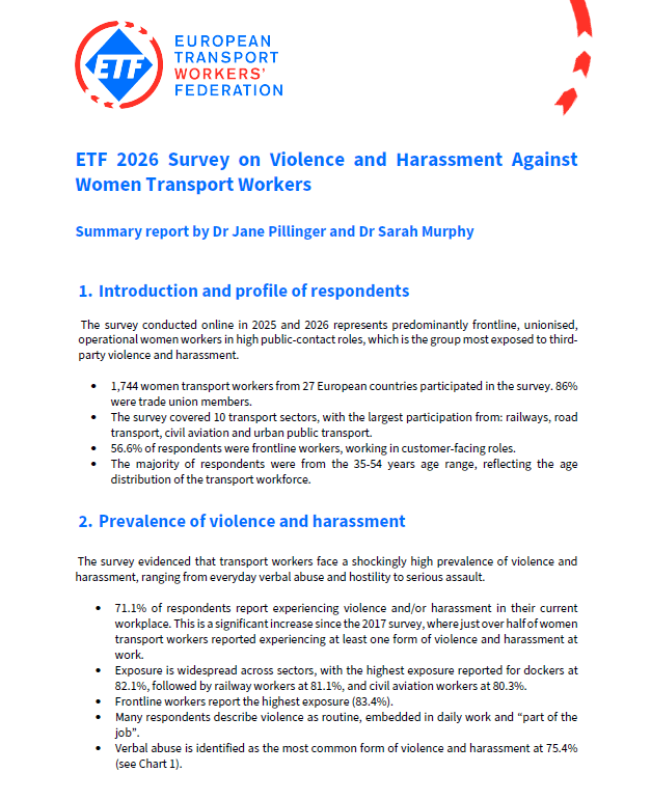
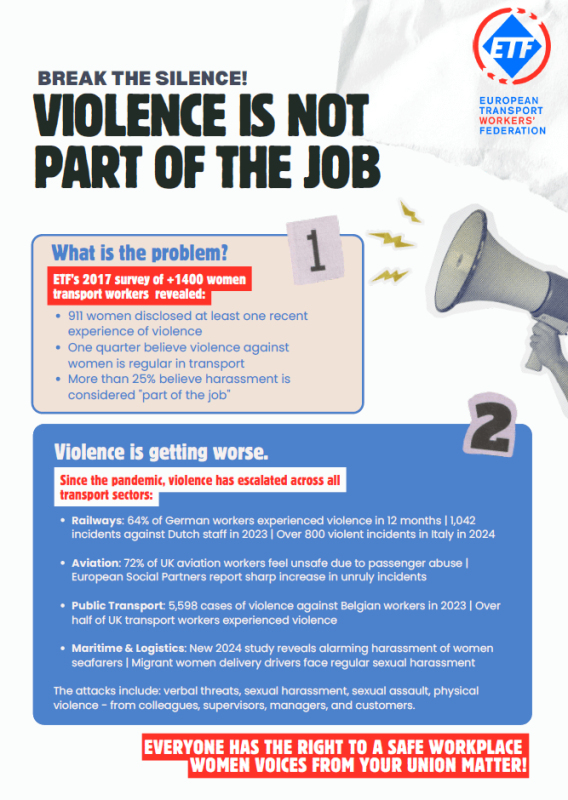
ETF survey exposes shocking levels of violence and harassment against women transport workers
Pride Month: “Equality Is Not Declared: it must be Built” – An Interview with Béatrice Lestic
ISSUES
The European transport sector is undergoing rapid change, shaped by globalisation, digitalisation, automation, demographic shifts and climate change. Yet there is little awareness of how these trends specifically affect women transport workers.
Digitalisation and automation often have a disproportionately negative impact on women’s jobs in certain sectors, but they also create new opportunities. These opportunities must be shaped to ensure that women are not left behind but instead benefit from the transformation of transport.
ETF Women’s Committee Priorities 2022–2027
Campaign: “Yes! More Women in Transport – make the sector fit for women to work in.”
Shaping digitalisation and automation so that new technologies create opportunities rather than barriers for women workers.
Fighting violence against women in the transport sector, including gender-based violence, harassment, and sexual harassment.
Violence remains a major obstacle for women across all transport modes — a problem made worse by the Covid-19 pandemic, both in the workplace and at home. The pandemic also accelerated digitalisation, while the green transition leans heavily on innovation, automation, and AI. These changes must be shaped to ensure that women are protected, empowered, and fully included in the future of transport.
Women transport workers also face shocking levels of harassment and violence. Until these problems are addressed, women’s participation and leadership in the sector will not improve significantly.
The ETF Women’s Committee strives for the improvement of women’s employment and quality of work. We campaign for a violence-free workplace and fight against the social dumping and precarious work that affect women transport workers.
EU social dialogue brings together organisations which represent workers and employers, known as social partners. The EU supports social dialogue at European level and the ETF is a recognised social partner in seven sectoral social dialogue committees (SSDCs). They meet regularly on a basis to discuss issues affecting their sector such as training, occupational health and safety, or new forms of work.
Although there is no social dialogue committee dedicated to women in transport, many of the committees discuss gender related topics.