Railways
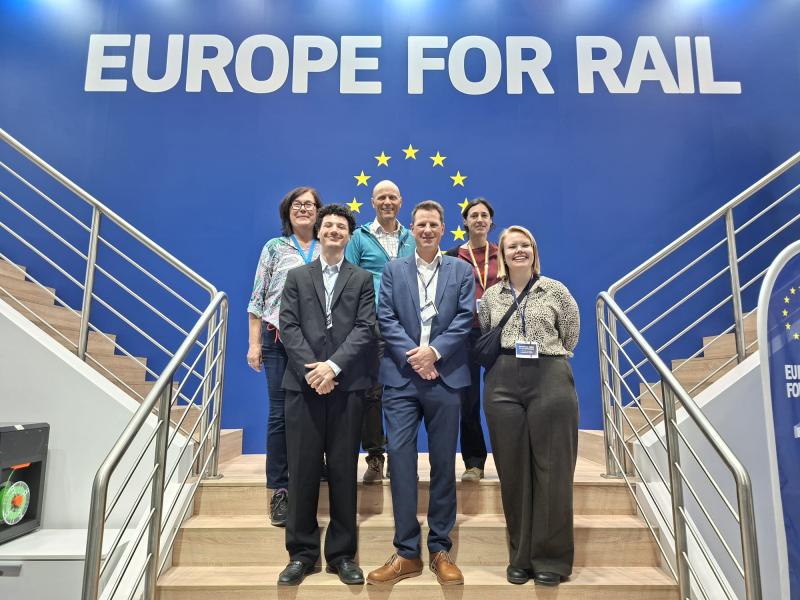
ETF railway affiliates visit DAC testing facility in Berlin
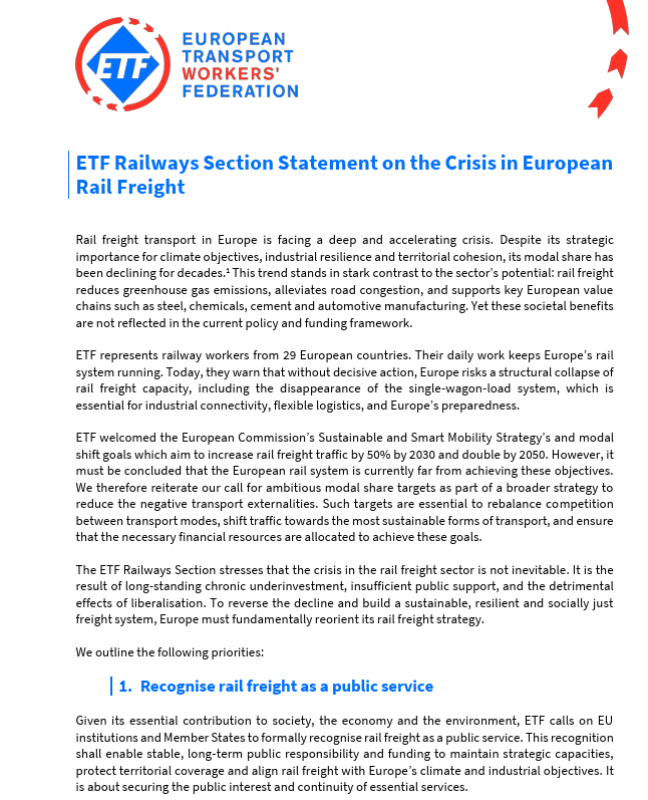
ETF Railways Section proposes 7 measures to reverse the agony of the rail freight sector in Europe
PRIORITIES
Our priorities for 2022 – 2027 are:
- Promoting public railways
- Safety and security on European railways;
- Attracting young and female workers to the rail industry to face the demographic challenge. This can only be achieved by providing good working conditions and wages for all workers in the sector;
- Digitalisation and Automation: A just transition, workers’ involvement in developing and introducing new technologies and adequate (re-)training schemes;
- Social dialogue: Achieving binding results with our social partner, CER, that effectively improve the working conditions of railway workers and making sure previous agreements are implemented and respected.
Contact us
- We develop industrial campaigns to show strength and make our voice heard.
- We participate in the European Sectoral Social Dialogue for the railway sector.
- We influence railway policy and legislation.
- We get involved in the European Union Agency for Railways (ERA) which is developing technical ‘standards’ and harmonised railway safety policies very relevant for railway workers conditions.
- We follow the “Europe’s Rail” research program that is funding projects relevant for digitalisation and automation of the railways demanding accompanying social impact research funding.
Railways are the backbone of a sustainable transport system. For 20 years Europe’s railway sector has been undergoing constant reforms and restructuring – partly imposed by EU legislation, partly by national governments or company decisions.
- Promoting quality railway employment – fighting liberalisation and privatisation.
- Promoting Fair Transport – fighting social dumping in the railway sector in Europe, for labour and trade union rights and social protection in a liberalised rail sector.
- Ensuring railway safety and security in a changing railway world
The ETF is the recognised social partner for the railway sector, representing railway workers. Together with the employers’ organisations — the Community of European Railway and Infrastructure Companies (CER) and European Rail Infrastructure Managers (EIM) — we form the Sectoral Social Dialogue Committee for Railways.
Our shared goal is to ensure that Europe’s railway policy guarantees decent working conditions and respect for workers’ rights. Through social dialogue and consultation with the European Commission, we address new developments in the sector and engage with all stakeholders on current challenges.
Our Priorities
- Increasing the employment of women in the railway sector.
- Ensuring railway safety by upholding qualification requirements for safety-critical staff and monitoring driving times.
- Supporting employability in the face of digitalisation and automation.
We pursue these goals through joint projects, recommendations, agreements, and working groups with our social partners.
Vacancy – Traineeship for Railways
The section meets twice per year and every four years, before the ETF Congress, it elects its Steering Committee and adopts a work programme.
The Steering Committee is chaired by the Section President and it is composed of two vice-presidents, a representative of women railway workers, a representative of young railway workers and 3 ordinary members.
The Railway Section is supported by three advisory groups: one that brings together locomotive drivers; one that brings together on-board personnel; and one that represents workers in maintenance workshops.
The ETF is a member of the Management Board (without voting rights) of the European Union Agency for Railways (ERA) and nominates trade union experts for relevant ERA working groups.