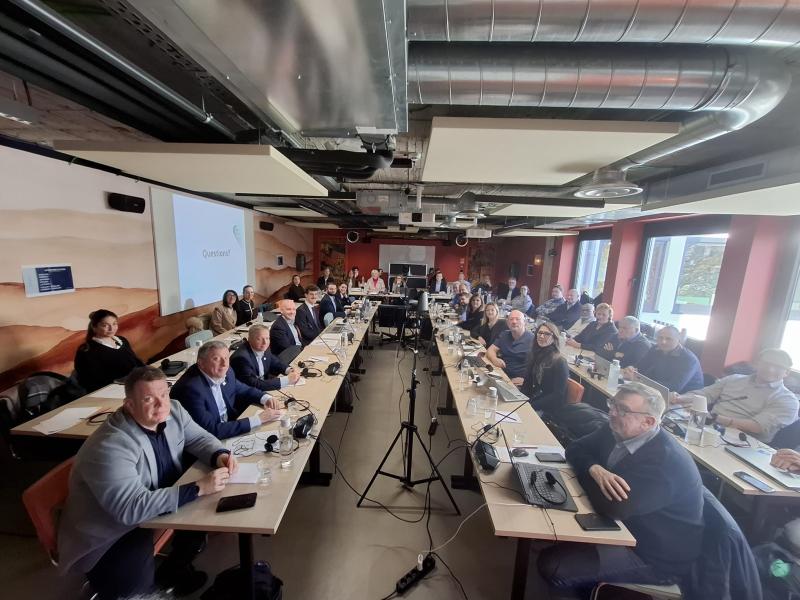


A packed hearing in the European Parliament on June 24 exposed the harsh realities of subcontracting in Europe’s logistics sector, as the European Transport Workers’ Federation (ETF) and the European Trade Union Institute (ETUI) launched a new report revealing systematic worker exploitation. The event, hosted by MEP Estelle Ceulemans (S&D), gathered trade unionists, policymakers, representatives of the EU Commission, and researchers to discuss the findings of “Sorry, We Subcontracted You.”
The report documents how complex subcontracting chains are being used across the EU to shift responsibility, reduce wages, and suppress workers’ rights — particularly affecting migrant and third-country national workers. Union representatives stressed that this is not a loophole, but a deliberate and growing business model that traps workers in precarious and unsafe conditions.
Event participants emphasised the urgent need to address abuse in subcontracting practices. Policymakers currently have their attention on the issue, with the Parliament preparing an own-initiative report on abusive subcontracting and the Commission acknowledging the problem and deliberating on the way forward. As the Commission considers its next steps, the findings of our study are expected to contribute to ongoing work on the Public Procurement Directive and the Quality Jobs Roadmap.
ETF General Secretary Livia Spera warned that “this model is creating a parallel labour market where rights don’t apply.” Representatives from across Europe shared harrowing examples, including drivers working extreme hours, denied sick pay, or dismissed without notice when a subcontractor disappears overnight.
ETUC General Secretary Esther Lynch called for swift EU intervention: “This report shows how powerful corporations are using subcontracting to dodge their responsibilities while workers pay the price. People delivering our parcels are often underpaid, overworked, and left without basic protections. It’s not fair, and it’s not sustainable. The EU needs clear rules to make sure companies can’t hide behind layers of subcontractors. Everyone who works deserves decent conditions and fair treatment — no matter who signs their contract.”
Both MEP Estelle Ceulemans and MEP Marianne Vind voiced strong support for legislative change. They stressed the need to act and ensure companies cannot wash their hands of responsibility for workers’ treatment.
Unions are calling for an EU-wide ban on subcontracting of core business activities, full chain liability, better labour inspections, and stronger enforcement of existing rules. While a representative from the European Commission’s DG Employment acknowledged the gravity of the issue, trade unionists warned that awareness is not enough — urgent action is needed.