

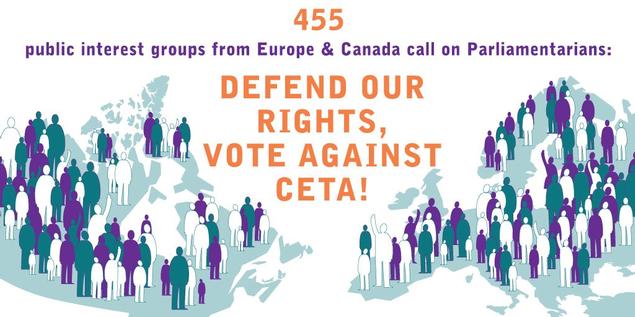
 455 European and Canadian civil society groups, including the ETF, have urged legislators in an open letter to vote against the Comprehensive Economic and Trade Agreement (CETA). “The ratification could weaken protections for workers and the environment, and provide foreign investors with extreme tools to attack public interest regulations” the joint statement reads.
A growing number of organisations from both sides of the Atlantic, trade unions, farmer associations, environmental, consumer and public health groups as well as human rights and digital rights organisations, express deep concern about the CETA text. Over 3.5 million people from all over Europe have signed a petition against the agreement and its twin, the EU-US Transatlantic Trade and Investment Partnership (TTIP).
ETF General Secretary Eduardo Chagas: “We are not opposed to trade, nor are we opposed to an agreement with Canada. But we are highly concerned about deals negotiated behind closed doors and without a meaningful involvement of civil society and the labour force. It is outrageous that the European Union is not only failing in its duty of democracy and social partnership – it also appears to be exporting an extreme model to other countries. With CETA, TiSA and TTIP it is pursuing a level of market access meant to benefit corporate interests, not people.”
The open letter highlights that:
- CETA is no progressive trade deal but even more intrusive than the old free trade agenda designed by and for the world’s largest multinationals.
- The deal features many worrying provisions that side-line the needs of people and the planet.
- There must be a paradigm shift towards a transparent and inclusive trade policy.
The ETF and ITF openly denounce the substantial democracy deficit dominating the negotiations and the ratification process of this agreement. Both organisations support the call for voting against the ratification of the agreement by the European and Canadian Parliament as well as national, provincial and regional parliaments with a say in the ratification.
The ETF opposition against any policy or agreement that puts at threat workers’ rights, full employment, decent working and living conditions for all fits in its continuing campaign for fair transport in Europe. Join us in demanding real political action from the European Commission to immediately stop abuse and modern slavery in the EU transport market.