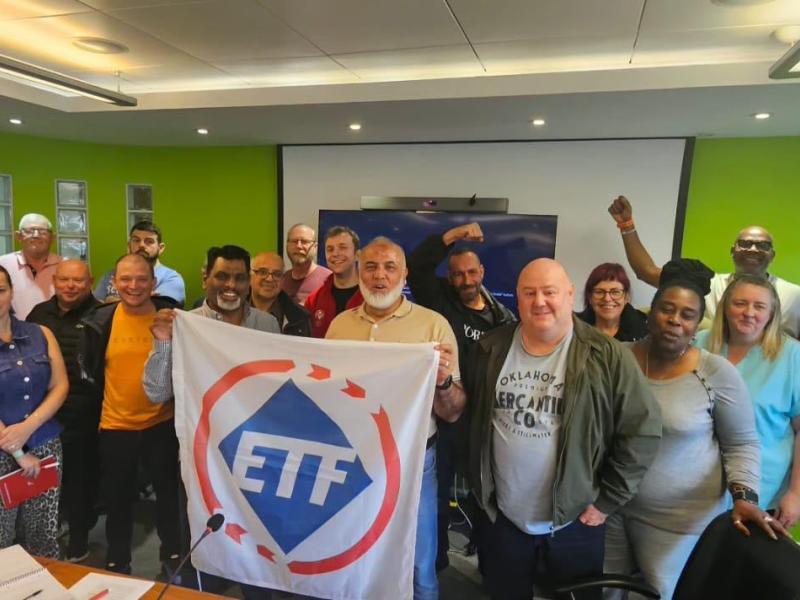


This week, ETF affiliates from across Europe met in Brussels to discuss the ongoing restructuring of UPS operations in Belgium and the UK. More than half the workforce in each country faces redundancy, to be largely replaced by workers doing the same jobs, in a subcontracting chain, on more precarious terms. For trade unions, this is not restructuring. It's social dumping continuing to spread through the sector.
When transport unions gathered in Brussels to exchange experiences from their respective countries, they discovered striking similarities. What initially appeared to be separate national disputes revealed itself as part of a broader, common pattern. It was a model that transport unions have long raised concerns about, and one that is now being pushed deeper into the logistics giant's operations.
In Belgium, more than half of the workforce currently faces redundancy as UPS switches to subcontracting. In the UK, Unite reports that UPS intends to stop directly employing frontline delivery staff by June 2027, relying instead on self-employed drivers using their own vehicles, with the remaining workforce transferred to third-party employers a reduction from around 4,000 workers to roughly 800 across 51 sites.
This model produces a company where fewer and fewer UPS workers ever touch a thing. The brand, and the profit stay with UPS while the risk, the cost pressure and the liability are pushed down the chain to the workers.
The pattern is the same in both countries but during the meeting, it became evident that it is not only the UK and Belgium facing this shift from direct employment to precarious forms of employment but it is happening all over Europe. OGB-L informed during the meeting that it has been an issue for a longer time in Luxembourg and that the subcontractors themselves are faced with unrealistically high fines when packages get lost and they get replaced as soon as they can find cheaper one.
A profitable company: putting shareholders before workers
What makes this so difficult to accept for unions is that UPS is not a company in complete distress - it remains profitable. While it continues to pivot its business into other segments of the logistics sector, it should focus on retaining its well trained and professional workforce rather than sacrificing them simply in pursuit of lower labour costs.
Affiliates were clear that restructuring of this kind is a choice, not a necessity and that it carries consequences well beyond the workers directly affected.
Where subcontractors compete against one another purely on price, quality suffers alongside conditions: higher staff turnover, less training, more safety breaches, and a service that gets worse for customers.
Unite has condemned the plans in the strongest terms, saying it is astonished that a household name is willing to damage its reputation and risk its client base simply to lower costs, and warning that the proposals are bad news for workers, clients and customers.
Why the rules have to change
The example of UPS is one of the reasons ETF has been calling for limits on abusive subcontracting for years. As we set out in June, subcontracting across European logistics has stopped being a way of handling peaks in demand and has become the way of doing business.
Voluntary commitments and corporate social responsibility statements have not stopped it. Only binding rules will. ETF and our affiliates continue to call on European lawmakers to:
- Limiting subcontracting chains to a maximum of two levels. Endless chains serve no legitimate business purpose. They exist primarily to obscure responsibility and reduce costs at the expense of workers
- Ensuring equal treatment across subcontracting chains by establishing joint and several (full chain) liability, ensuring all entities (client, contractors and subcontractors) are accountable. This should cover a range of issues including remuneration, social security contributions, taxes, health and safety, and collective bargaining rights.
- Regulating labour intermediaries by standardising the role and responsibilities of recruiting and placement agencies, and other intermediaries across the EU.
By the end of this year, the European Commission will propose its Quality Jobs Act. If the act is to mean anything for transport and logistics workers, it must regulate subcontracting directly, otherwise companies will also follow in the footsteps of UPS: subcontracting to keep the profit and while (sub)contracting out the responsibility.
ETF stands in full solidarity with UPS workers and with our affiliates defending them.