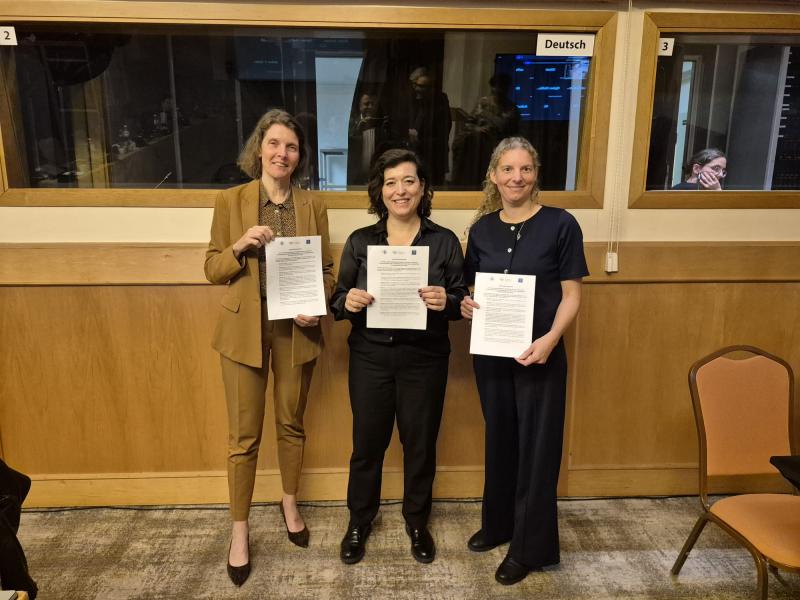
Trade unions and responsible road transport companies share a common goal: Strong rules to stop abusive subcontracting and build a fairer road transport sector. This was one of the conclusions from yesterday’s ETF-UETR event in the European Parliament, hosted by Swedish S&D MEP Johan Danielsson and attended by more than 60 participants.
Trade unions, employers, the European Labour Authority (ELA) and policymakers, including Executive Vice-President and Commissioner Roxana Mînzatu, came together to discuss how Europe should tackle abusive subcontracting, protect workers and ensure fair competition. The discussion focused on the need for clear rules on responsibility in subcontracting chains. Workers must know who their real employer is, who sets the price, who is responsible for wages and working conditions, and who is accountable when rules are broken.
Prevention, enforcement and sanctions
Referring to the European Parliament's February vote on his report on subcontracting, Johan Danielsson rejected claims that stronger rules would harm small and medium enterprises (SMEs). On the contrary, UETR, representing around 70,000 road transport SMEs, joined ETF in calling for stronger legislation, including limits on contracting and subcontracting chains. Abusive subcontracting hurts both workers and responsible employers. It allows unfair business models to undercut companies that respect the rules while driving down wages and working conditions.
MEP Danielsson referred to the recent Swedish illegal cabotage case where a truck driver was stopped over documentation discrepancies, exposing a subcontracting chain starting from the major logistics operator Kuehne+Nagel at the top and a Latvian carrier at the end. The driver was dismissed by the company and left to deal with the consequences He also highlighted three areas where action is needed: prevention, to stop abusive business models from taking root, stronger controls and enforcement with an important role for ELA, and sanctions that genuinely deter companies from breaking the rules.
Workers and companies must work together
ETF General Secretary Livia Spera and the UETR President Alexis Gibergues both stressed that subcontracting is not the problem, but how subcontracting is organised in a way to press down prices and wages for smaller companies and drivers at the end of the chain.
"There can be no quality jobs in road transport without fair subcontracting. Workers need transparency, accountability and clear responsibility throughout the supply chain. That is why ETF is calling for subcontracting chains to be limited to a maximum of two levels, joint and several liability, strong rules for labour intermediaries, and stronger enforcement to ensure the rules are respected in practice. The Quality Jobs Act must deliver strong rules that protect workers and stop abusive business models." (Livia Spera, ETF General Secretary)
Alexis Gibergues, himself a haulier, pointed to the pressure on companies at the bottom of long subcontracting chains.
"Subcontracting is not the problem, opacity is. When the smallest haulier carries the truck, the driver, the fuel and the risk and is paid last, everyone loses. Employers and workers are asking Europe for the same thing: look at the whole chain, make it transparent, and enforce the rules." (Alexis Gibergues, UETR President)
The Commission and ELA support stronger action
Commissioner Roxana Mînzatu referred to the recently presented Fair Labour Mobility Package and the ongoing work on the Quality Jobs Act. She highlighted transparency, liability and stronger enforcement as key issues. Workers, companies and inspectors all need a clearer picture of what happens throughout subcontracting chains. She also stressed that there can be no exceptions for mobile sectors such as road transport when it comes to protecting workers and ensuring fair labour mobility.
ELA Executive Director Cosmin Boiangiu described road transport as a priority sector due to the high risk of labour abuses. He pointed to challenges such as bogus self-employment, non-genuine posting and complex subcontracting chains. ELA is working to strengthen cooperation between national enforcement authorities, improve training and make better use of digital tools to target complex cross-border cases involving labour intermediaries and large operators.
Liverpool statement sets the course for action against abusive subcontracting
An ETF Road transport conference took place in Liverpool earlier this month, where unions from across Europe examined the growing impact of subcontracting on workers and responsible operators. Hosted by our ETF affiliate Unite the Union, the conference brought together trade union representatives, enforcers and stakeholders from across the sector. Participants adopted a road section statement calling for stronger EU action to tackle abusive subcontracting, including limiting subcontracting chains to a maximum of two levels, introducing joint and several liability, and establishing strong EU rules for labour intermediaries. The conclusions adopted in Liverpool provided a strong foundation for yesterday's discussion in the European Parliament.
Next steps
ETF affiliates welcomed the participation of Commissioner Mînzatu and ELA, as well as ongoing initiatives such as the Fair Labour Mobility Package and ELA's remuneration tool. They also recalled the Commissioner's visit to a truck parking area last year, where she met drivers and saw first-hand the realities many transport workers face.
Participants thanked UETR for joining forces with ETF in the fight against abusive subcontracting. This cooperation should now grow stronger, with more responsible companies speaking out for fair competition and decent work.
The focus now turns to the upcoming Quality Jobs Act, where ETF will continue pushing for strong EU rules on limits to the number of chain levels, liability, transparency and enforcement throughout subcontracting chains. On 1 December, ETF, EFFAT and EFBWW will mobilise in Brussels to demand ambitious action on subcontracting and quality jobs in Europe.