

ETF endorses and echoes recommendations from ETSC’s (European Transport Safety Council) report on how to improve the safety of goods vehicles in the EU.
We particularly see eye-to-eye on the requirements to step up law enforcement for HGVs (heavy goods vehicles) and LGVs (light goods vehicles), to extend the EU training requirements to LGV drivers, to improve direct vision for HGVs and to step up measures against speeding.
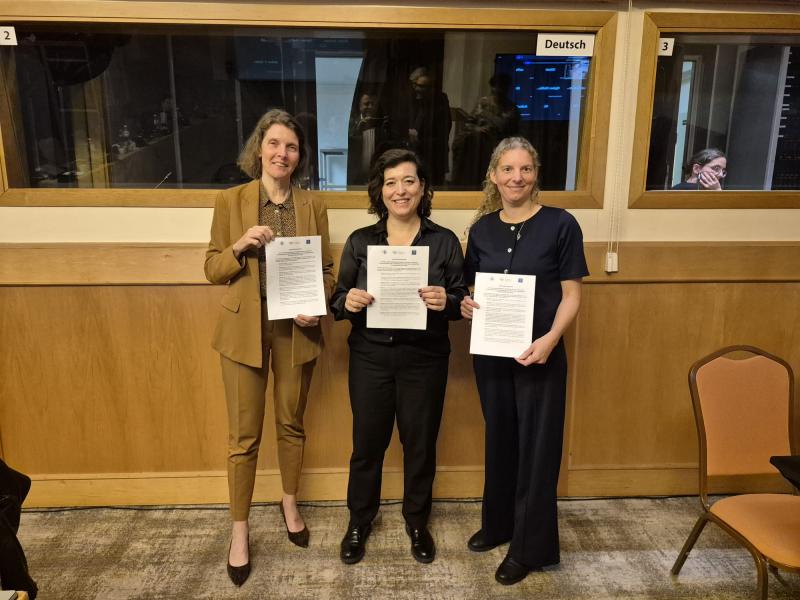
“We fully endorse the report and are happy to see that we have a partner to work with, in our fight for road safety, both for professional drivers and road users. This report has opened up further opportunities for collaboration. Two voices are stronger than one, and we plan on actively working together to ensure that these recommendations are implemented,” excalimed Livia Spera ETF General Secretary.
“Thousands of people are still dying in collisions involving goods vehicles in the EU every year: many goods vehicle drivers, but even more car occupants and vulnerable road users. The solutions to preventing many deaths associated with goods vehicles are available off the shelf and have been for years. There are some great examples of cities and countries taking bold action across Europe, but collectively, also in partnership with the ETF, we can and must do better,” added Antonio Avenoso Executive Director of ETSC.
EU law – now and in future
In the soon to-be-adopted Mobility Package, light goods vehicles over 2.5t are set to benefit from the same legal regime as heavy good vehicles. They will have to be equipped with tachographs, and drivers will have to comply with daily and weekly driving time limits. This is a step forward; however, ETF and ETSC share the view that there is a need for the current CPC requirements (professional driver training) to be extended to all professional drivers, including LGVs. Driver training is an essential tool for reducing work-related road risk as well as guaranteeing law compliance, and leaves no doubt that drivers are qualified professionals.
An emphasis on driver fatigue
The ETSC report points to fatigue as a significant risk factor affecting heavy and light vehicle drivers alike, and as a significant factor in approximately 20% of commercial road transport collisions. The ETF and the ETSC share the same views here as well. Frequent breaks, adequate rest conditions away from the vehicle and strict enforcement of future rules on driving and rest time will be crucial in keeping roads safe in the EU.
Facts and figures relating to driver’s fatigue are brought to the surface by the ETSC who clearly states that good quality data on fatigue-related collisions are lacking. Indeed, the ETF cannot emphasise this enough; there is a clear need for robust data, without which policymakers cannot commit to future policies and actions centred on road safety and driver health and safety.
The ETF and the ETSC have a long-standing cooperation in lobbying for the safety of drivers and road users. We see scope for further collaboration in these recommendations, particularly since ETF is also working on a project for safer roads in Europe which will provide additional data.
ETSC’s newly published report will also provide food for thought for policymakers. It shows that 22,650 people lost their lives on EU roads in 2019, representing a 3% reduction compared to 2018. While there has been progress over a longer period, it is not enough to meet the 2020 target. Since 2010, EU countries achieved an overall reduction in road deaths of 24%, which equates to a 2.7% annual average reduction. A 6.7% year-to-year reduction was needed over the 2010-2020 period to reach the 2020 target through constant progress in annual percentage terms. This reduction was not achieved and, with the target now only one year away, it is out of reach.
Strong political will and urgent measures are needed in all EU Member States to narrow the gap between the desired and the actual EU progress. It is vital to have a clear and common approach, and together we present a united front that will bring these recommendations to the European Union and Member States, and ensure that they are implemented. EU institutions, EU member states, other European governments and local authorities all have a role to play in keeping our roads safe!