

Today the European Parliament voted in favour of liberalising bus and coach services in the EU. With this vote, the European Parliament gives a worrying signal to EU citizens just before the EU elections: opening markets has priority over the defense of quality services and decent work. Vulnerable communities are at risk of losing their transport links, because unleashing competition in the sector will focus provision on the most profitable routes. Meanwhile, budget companies like Flixbus will have free rein to expand their low-wage employment model to drivers across Europe.
“This vote will only serve to hit passenger transport workers with the same social dumping that their colleagues in the freight sector already face. This disappointing decision undermines all plans for a more social Europe! We will inform our drivers about this vote, and the risks it creates for passengers and workers who depend on the bus and coach industry. Let’s see how they react at the ballot box in May, when they’ve see who is responsible for this bad vote, and who supported our union vision.” said Frank Moreels, President of the European Transport Workers’ Federation (ETF).
This decision is even more frustrating because it comes at a time when other reforms affecting bus and coach drivers are in limbo. There is still no clarity whatsoever on how new rules that govern pay for posted workers will apply to bus and coach drivers, because the so-called Mobility Package 1 is completely blocked in the EU’s legislative machine.
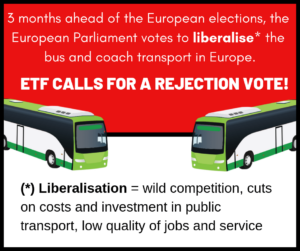
Sadly our pleas to reject the proposal fell on deaf ears
“The ETF will now have to reconsider its options with regards to Mobility Package 1, because this green light to the liberalisation of road passenger transport in Europe means a fundamental change in the structure of the industry. We’ll take the time to discuss all this next week, at our ETF Road Section annual meeting. Decisions will be made accordingly,” said Roberto Parrillo, ETF Road Section President.
“The ETF is in full campaign mode for Fair Transport, and on 27 March we will protest against social dumping in Brussels. We take this decision as an attack on the quality of service and the quality of jobs in Europe’s bus and coach sector – we will make our dissatisfaction known!” said Eduardo Chagas, the ETF General Secretary.
[ENDS]
Click here to see our statement before the vote.
For more information and interviews please contact:
Bryn Watkins, European Transport Workers’ Federation
Communications Officer
b.watkins@etf-europe.org
+32 470 93 05 90