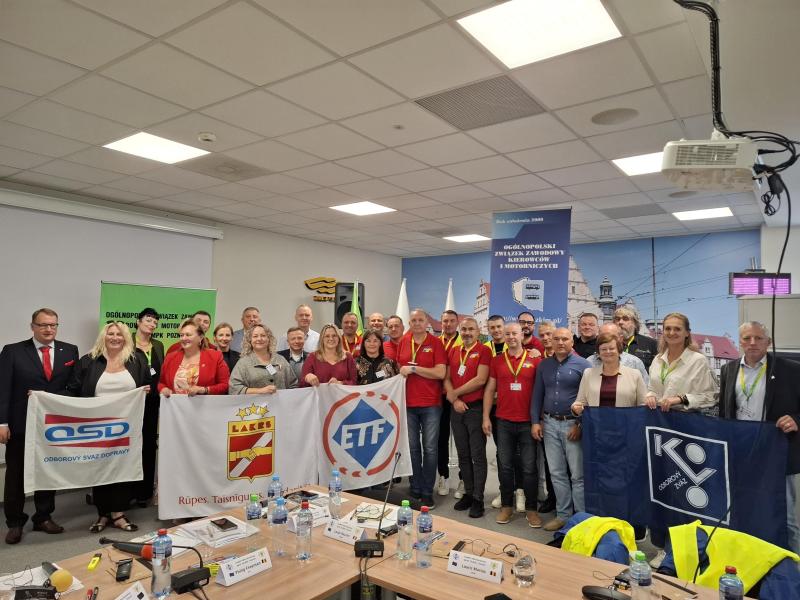
EU Social Partners in the Fisheries Sector, the European Boating Industry, MEP Sofia Ribeiro and the European Commission met to close the legal gaps existing in the fishing and boating industries with regard to recognition of certificates, free movement of workers and safety.
On Friday 29 May 2015, in the frame of the European Maritime Day, Europêche*, the European Transport Workers’ Federation (ETF )** and the European Boating Industry, organised with the support of the European Commission a workshop attended by Member of European Parliament Sofia Ribeiro (Employment Committee), representatives from the European Commission and key maritime stakeholders. Discussions took place to adequately address the problems faced by the fishing and boating industries in Europe, owing to the lack of recognition of qualifications of personnel on fishing and small commercial vessels.
The EU Sectoral Social Dialogue Committee for Fisheries (SSDC-F) works towards the enhancement and improvement of safety and vocational training, prevention of accidents at sea, workplace health and recognition of certificates. As for the latter, over the past few years and despite a single internal market and simplified administrative procedures to live and study anywhere in Europe, the European Social Partners (ESP) have repeatedly reported that fisheries professional qualifications are still not accepted across EU countries.
Over the past decade the SSDC-F has been advocating the transposition of the International Convention on Standards of Training, Certification and Watchkeeping for Fishing Vessel Personnel*** (STCW-F, 95) in Europe through an EU Directive, similar to what the EU has done for the shipping sector. This Convention is the first attempt to make standards of safety for crews of fishing vessels mandatory internationally, including basic safety training**** for all personnel regardless of the size of the fishing vessel. In this sense, it would not only improve safety at sea in fishing but also further enhance the free movement of fishermen through its own system for recognition of fishers’ certificates of competence. However, this Convention is only useful if implemented through EU/national legislation.
Through this workshop representatives from both sectors highlighted the impact of the lack of recognition of qualifications on maritime employment, safety at sea, vocational training and nautical tourism and discussed possible solutions. The ESP particularly drew EU Member States’ attention to the absolute need to enhance further safety at sea in the EU.
Mr Cor Blonk, Chair of the SSDC-F declared that: “For far too long our fishermen have been working under conditions with no satisfactory framework to guarantee their safety on board. The safety of human life is of such paramount importance that this must be at the forefront of EU and national legislation. Therefore, only through true implementation of key international instruments in our legal systems can we ensure fishermen´s integrity at sea.”
Cor Blonk added that: “I welcome the recent adoption by the EU Institutions of the Council Decision authorising Member States to become party to the STCW-F 95, which represents a major step in the short-term for the fishing industry towards a satisfactory framework to guarantee safety at sea and work mobility. However, given that the Convention has received relatively little attention among EU Member States in the past, the ESP consider it to be of utmost importance that Member States no longer delay the ratification of the STCW-F Convention and feel prompted to investigate its possible transposition into Community law by means of a proper EU Directive.”
*Europêche represents the fisheries sector in Europe. Currently, the Association comprises 12 national organisations of fishing enterprises from the following 9 EU Member States: DE, DK, ES, FR, IT, MT, NL, PL, UK.
**The European Transport Workers’ Federation (ETF)represents more than 3.5 million transport workers from more than 230 transport unions and 41 European countries, in the following sectors: railways, road transport and logistics, maritime transport, inland waterways, civil aviation, ports & docks, tourism and fisheries.
***IMO STCW-F convention has come into force on 29 September 2012. Only 4 EU Member States (Denmark, Lithuania, Latvia and Spain) have ratified the text so far.
****STCW-F, ANNEX, Chapter III, Regulation 1 “All fishing vessel personnel shall receive pre-sea basic safety training approved by the Administration of the flag state in personal survival techniques, fire prevention and fighting, emergency procedures, elementary first aid, prevention of marine pollution and prevention of shipboard accidents”
For further information, please contact:
Livia Spera, ETF Political Secretary (+32.496.65.79.15 or l.spera@etf-europe.org)
Daniel Voces, Europêche Policy Advisor (+32.2.230.48.48 or daniel.voces@europeche.org)