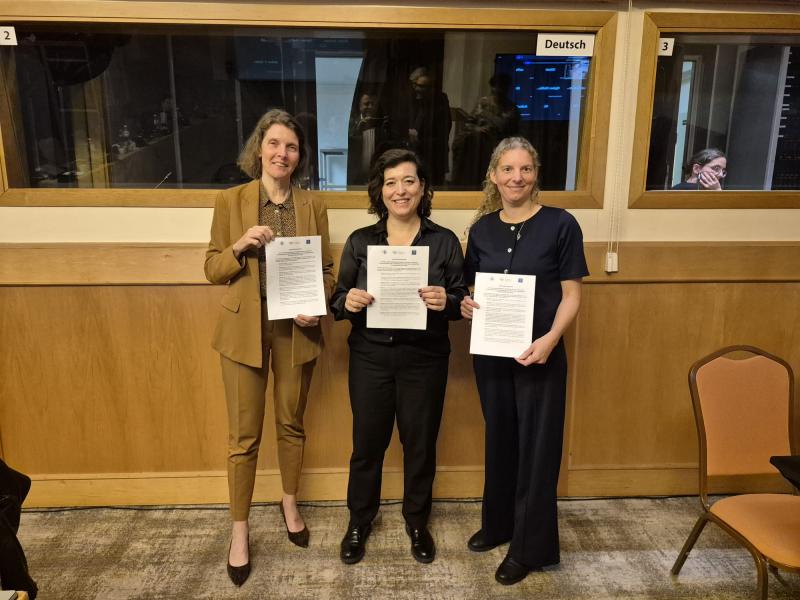
The second workshop of the EU co-funded Empowering Transport Workers in Central and Eastern Europe (UNIONDRIVE) project took place on 24 June 2026 in Warsaw under the title “Up in the Air – The Reality of Working in Civil Aviation in the 21st Century”. Co-hosted by the Transport Secretariat of NSZZ Solidarność, the event brought together trade union representatives, labour authorities and aviation experts to discuss some of the most pressing challenges facing aviation workers today.
Participants exchanged views on bogus self-employment, organising and collective bargaining, fatigue, health and safety, and violence at work, while sharing experiences and best practices from across the sector.
Tackling violence and disruptive passenger behaviour
The first panel explored the growing problem of disruptive passenger behaviour and its impact on aviation workers. Speakers discussed the many factors contributing to passenger misconduct, including overbooking, increased automation, natural disasters, cultural differences, political crises, everyday stress and, in some cases, excessive alcohol consumption.
Participants stressed the importance of awareness-raising campaigns targeting passengers, particularly as incidents have increased significantly since the COVID-19 pandemic. According to the International Air Transport Association (IATA), flight crews report at least one unruly passenger incident every 480 flights worldwide. Data from the European Union Aviation Safety Agency (EASA) also highlights the scale of the problem, with disruptive behaviour occurring every few hours and the most serious incidents occasionally forcing aircraft to make emergency landings.
Alongside trade union representatives, the panel featured a representative of the Polish Civil Aviation Authority (ULC), who shared the regulator’s perspective on addressing these incidents.
Bogus self-employment: where flexibility becomes precarity
The second session focused on bogus self-employment, a particularly widespread issue affecting pilots and cabin crew in Poland. Participants examined the increasing use of business-to-business contracts and other atypical forms of employment, discussing how these arrangements often disguise regular employment relationships while shifting risks onto workers.
The discussion considered where labour market flexibility ends and precarious work begins. Recent research by Ghent University, repeated in 2025, illustrates clear regional differences: while over 92% of aviation workers outside Eastern Europe reported having permanent employment contracts, more than half of respondents in Eastern Europe indicated that they worked under atypical employment arrangements rather than standard employment contracts.
The panel also benefited from the participation of Poland’s Chief Labour Inspector, who provided valuable insights into labour inspection and enforcement.
Fatigue: a growing occupational safety challenge
The third panel addressed one of the aviation sector’s most significant occupational health and safety challenges: fatigue. Participants reflected on how aviation professions have evolved over recent decades. Once widely perceived as prestigious careers offering adventure and attractive working conditions, the reality for many aviation workers today is characterised by increasing workloads, irregular schedules and chronic fatigue.
The discussion examined the effects of fatigue on workers’ wellbeing and flight safety, while also highlighting the importance of effective fatigue risk management and workers’ rights to report when they are unfit for duty.
Strengthening collective bargaining across a diverse workforce
The final panel focused on organising aviation workers and strengthening collective bargaining. Participants discussed the diversity of occupations across airlines and airports, where workers often have very different employment statuses, qualifications and working conditions.
Speakers exchanged experiences on how trade unions can organise workers employed under various contractual arrangements and highlighted the benefits of collective bargaining in improving wages and working conditions. The discussion also explored the legal framework for organising workers in Poland and demonstrated how strong trade unions continue to play a crucial role in protecting workers’ rights across the aviation sector.
Looking ahead
The workshop concluded with a shared commitment to continue the discussion during a second Polish UNIONDRIVE workshop scheduled for November 2026, which will focus more specifically on minimum wages and collective bargaining developments in the transport sector.
Stay tuned for more updates from the UNIONDRIVE project as trade unions across Central and Eastern Europe continue working together to strengthen workers’ rights and build fairer labour markets.