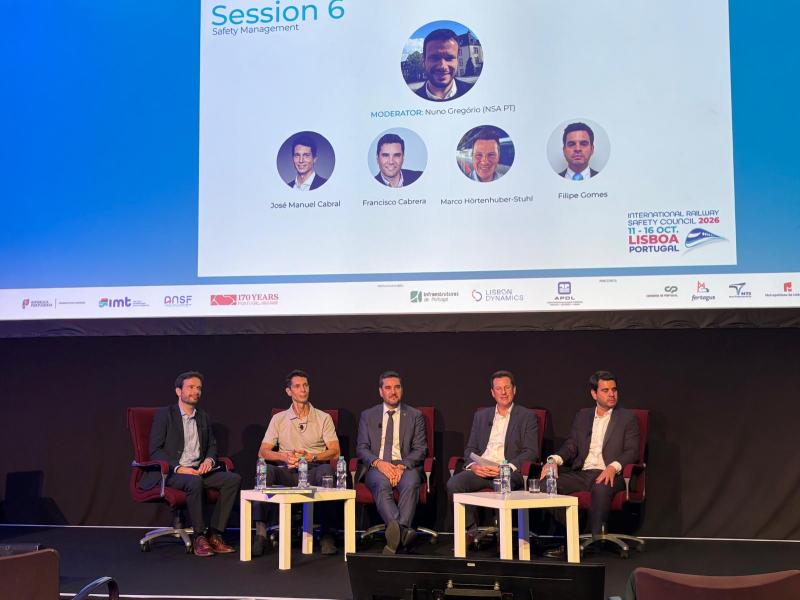


At the International Railway Safety Conference (IRSC) 2026 in Lisbon, ETF Technical Coordinator and locomotive driver Marco Hörtenhuber-Stuhl presented the European Transport Workers' Federation's vision for monitoring working, driving and rest time as a core railway safety tool. His presentation,"Monitoring Working Time as a Railway Safety Tool: From Compliance to Proactive Risk Management", argued that effective monitoring is not merely an administrative or labour-law requirement, but an essential component of modern railway safety management.
The presentation highlighted a growing challenge for the European railway sector. Liberalisation, cross-border operations, multiple employment relationships and new forms of work organisation have increased the complexity of managing working time. While railway undertakings may only see part of a worker's schedule, the train driver experiences the full workload and the cumulative effects of fatigue.
ETF's key message was clear: fatigue risks must be identified before they affect railway operations. Current systems often focus on recording working time after duties have been completed, primarily for compliance and inspection purposes. ETF believes that safety can be significantly enhanced when working-time data is used proactively, allowing unsafe rostering patterns, insufficient rest periods and excessive cumulative workloads to be detected before a safety risk emerges.
A central theme of the discussion was the need for an objective, reliable and interoperable monitoring system covering working, driving and rest times across borders, employers and employment arrangements. Such a system would provide a complete picture of a worker's workload while ensuring proper safeguards for privacy, data protection and worker involvement.
Importantly, the discussion at IRSC demonstrated broad recognition of the challenge. There appeared to be widespread agreement among participants that an objective and reliable tool to monitor the working, driving and rest times of train drivers is necessary to strengthen railway safety across Europe. Participants acknowledged that safety-critical decisions can only be effective when accurate and complete information is available. A monitoring system that provides visibility of fatigue risks before duties begin would therefore represent a significant step forward in protecting workers, passengers and the public.
ETF also stressed that any future system must be built on the principles of trust and just culture. Monitoring should be used to improve safety and compliance, not to individualise blame. Responsibility for unsafe rostering and breaches of working-time rules must remain with employers and organisational systems.
Looking ahead, ETF continues to support the work underway at European level to develop practical solutions that combine safety, interoperability and workers' rights. The Federation advocates for a common minimum dataset, cross-border interoperability, strong governance, and the integration of working-time monitoring into Safety Management Systems and fatigue risk management processes.
As highlighted in Lisbon, the railway sector already collects large amounts of working-time data. The real question is how that data is used. For ETF, the answer is simple: visibility is prevention. When working time becomes a safety signal rather than merely a record, railway organisations can prevent fatigue-related risks before they become incidents.