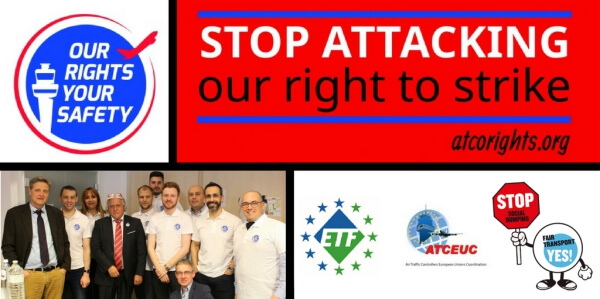
Almost 70 trade union representatives from all around Europe affiliated to the Air Traffic Controllers European Unions Coordination (ATCEUC) and the European Transport Workers’ Federation (ETF) gathered today in Brussels to discuss further steps in their campaign ‘Our Rights – Your Safety’, defending the right to strike of European air traffic management (ATM) staff.
The European Commission published in 2017 the Communication ‘Aviation: Open and Connected Europe (COM 2017) 286 final’, recommending that Member States introduce policies that limit the right to strike of ATM staff. The Communication significantly encroaches on the national sovereignty of Member States, contradicts the EU Treaties and violates the fundamental rights of workers in European air traffic management.
In response ATCEUC and ETF jointly launched a campaign calling on the Commission to respect workers’ rights as enshrined in the EU Treaties and the Charter of Fundamental Rights, and to refrain from any actions restricting these rights. In support of this campaign, an online petition was launched at www.atcorights.org.
The participants of today’s gathering were addressed by a number of speakers including Esther Lynch, the Confederal Secretary of the European Trade Union Confederation (ETUC), Klaus Heeger, Secretary General of the European Confederation of Independent Trade Unions (CESI), and Georges Bach, Member of the European Parliaments’ Committee on Transport and Tourism (TRAN). All the speakers insisted that the right to strike is a fundamental right and cannot be restricted by the Commission in any way.
Charles-André Quesnel, Chair of the ETF Air Traffic Management Committee, commented: “No one likes delays and cancellations, but strikes are not the problem. Industrial action by air traffic management staff causes less than 1% of flight delays in Europe while the airlines are responsible for over 50%. The proposals of the Commission are not proportional to the scale of the problem.”
Volker Dick, ATCEUC President, added: “The Commission’s role is to anticipate the changes provoked by the increasing numbers of flights and passengers. They should build a safe, stable future for the industry. Attacking the right to strike achieves none of this.”
François Ballestero, ETF Political Secretary for Civil Aviation, concluded: “As opposed to the Commissions’ minimum service, we want a maximum safe service. That means decent and stable jobs, functioning social dialogue and guaranteed collective workers’ rights. This will all contribute to a reliable and safe European aviation.”
The trade unions affiliated to ATCEUC and ETF, representing thousands of workers in the European air traffic management sector, are determined to defend their right to strike by all available means. While continuing efforts at EU level, they jointly decided today to move into the next phase by initiating actions at national and EU levels.
Find out more and sign the petition: www.atcorights.org
For questions or further information, please contact François BALLESTERO (ETF), f.ballestero@etf-europe.org, or Jean-Denis LARRERE (ATCEUC), larrere@atceuc.org.
Air Traffic Controllers European Unions Coordination (ATCEUC) was created in 1989 and is currently composed of 32 professional and autonomous trade unions representing more than 14000 Air Traffic Controllers and Air Traffic Safety Engineering Personnel throughout Europe. ATCEUC is an EU recognized social partner in air traffic management.
European Transport Workers’ Federation (ETF) represents more than 5 million transport workers and among them 386,000 civil aviation workers from 81 trade unions located in 42 European countries. It is a recognized social partner and the only representative of aviation workers across all sub-sectors (air traffic management, aircrew, ground handling, maintenance, etc.).