

As negotiations continue in the European Parliament on EU Inc., the proposed new European company regime, the European Transport Workers' Federation (ETF) is heavily concerned that this proposal could come at the expense of workers' rights and social dialogue. The initiative aims to make it easier for companies to operate across borders, but this must not weaken the social protections that are fundamental to the European model.
For transport workers, these discussions are highly relevant. Across aviation, maritime transport, rail, road transport, ports and logistics, workers already face the challenges of increasingly complex cross-border corporate structures. Any new European legal framework must therefore include strong safeguards against regulatory arbitrage, guarantee a genuine link between a company's registration and its economic activity, and fully respect existing labour and social rights.
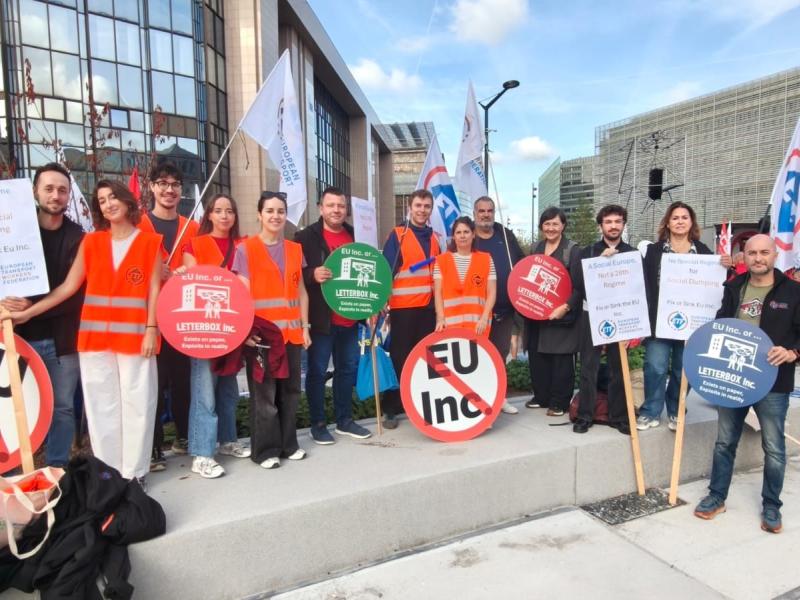
These concerns are reflected in the trade union mobilisations. On 24 September in Brussels, workers and trade unions gathered to demand that Europe's competitiveness agenda delivers quality jobs and strong social rights. The mobilisation will continue on 20 October in Strasbourg, where trade unions will once again call for a Europe that puts workers at the heart of economic decision-making.
Livia Spera, General Secretary of ETF:
"Europe needs innovation and sustainable growth, but not at the expense of workers' rights. The 28th Regime must not become a vehicle for weaker accountability, reduced worker participation or lower social standards. Europe's competitiveness and its social model must advance together."
The proposal is currently being discussed by both the European Parliament and EU governments. The final rules have not yet been decided and there is time to get the balance right. In particular, ETF calls on legislators to ensure that the final regulation:
- remains focused on supporting innovative start-ups and scale-ups;
- preserves the application of existing sector-specific legislation and enforcement mechanisms;
- protects workers' rights to information, consultation and participation;
- safeguards employees' rights and financial claims in insolvency situations;
- prevents the creation of company structures that weaken accountability or facilitate social dumping.
Europe needs innovation and competitiveness, but it also needs a strong social dimension. The two must go hand in hand.