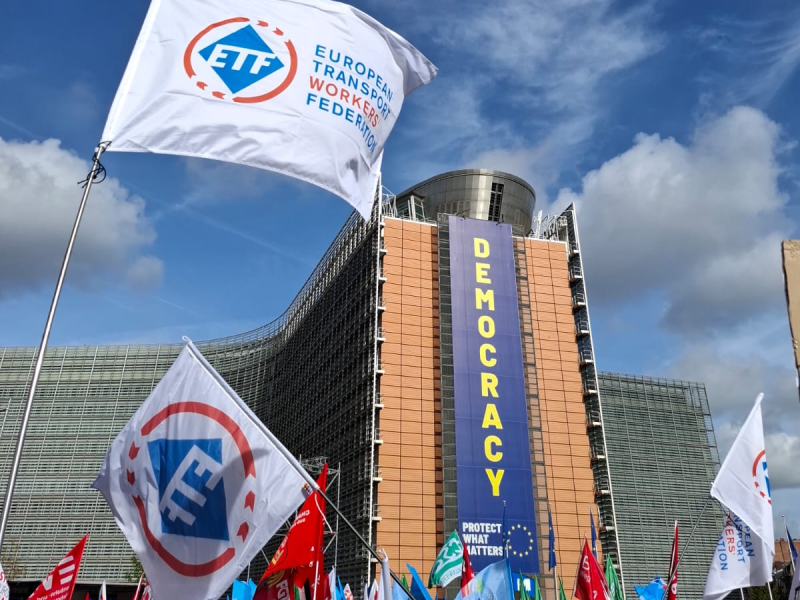
The climate emergency is a major challenge in the 21st century. The European Union, through the European Green Deal, is implementing initiatives to tackle greenhouse gas (GHG) emissions and aims to achieve a carbon-neutral EU by 2050. This objective is ambitious and will impact all economic activities in Europe and transport is at the core of these new policies as transport is a main contributor to GHG emissions and decarbonating it is a primary objective.
The changes envisaged will not only concern economic activities, business models, and investments, but will also have an impact on workers as they will raise new challenges related to employment, skills, and working conditions. While acknowledging the magnitude of the challenges ahead and the rapid changes they will entail, it is crucial that the trade union movement takes action to ensure that the necessary transformations are not at the expense of workers but bring opportunities for them. This particularly true for the transport trade unions. “Just transition” is a concept developed by the international and European trade union movements and recognised by the 2015 Paris Agreement, where it is stated that policy implementation should take into account “the imperatives of a just transition of the workforce and the creation of decent work and quality jobs”.
This “ETF Climate Change Toolkit for Transport Trade Unions” aims to raise awareness among ETF affiliates of climate change as a core trade union issue. Transport trade unions cannot wait but must act proactively in the interest of their members to ensure just transition.
This toolkit provides
- some basic background information on the science behind global warming and proposes a number of links for deeper digging into the topic (Chapter 1);
- an introduction on EU climate policies and the role of transport within global warming (Chapter 2);
- an overview over current state of EU policies to decarbonize transport (Chapter 3) including information on EU funding possibilities for just transition. Chapter 3 also includes as a good practice example the “French Climate and Resilience Law” in particular regarding its obligation for social dialogue at company level on environmental issues (Chapter 4);
- in its second part details regarding the transport modes, different alternatives and instruments considering the decarbonization of the rail, road, shipping and aviation sectors including possible impact on transport workers’ jobs and working conditions (Chapters 5 – 8);
- lastly recommendations for trade union action with some good practice examples (Chapter 9) and a check list for trade union representatives and for workers representatives at company level (Chapter 10).
We call on all ETF members and transport trade unions to use this toolkit as a means to get engaged, to shape and not to wait.