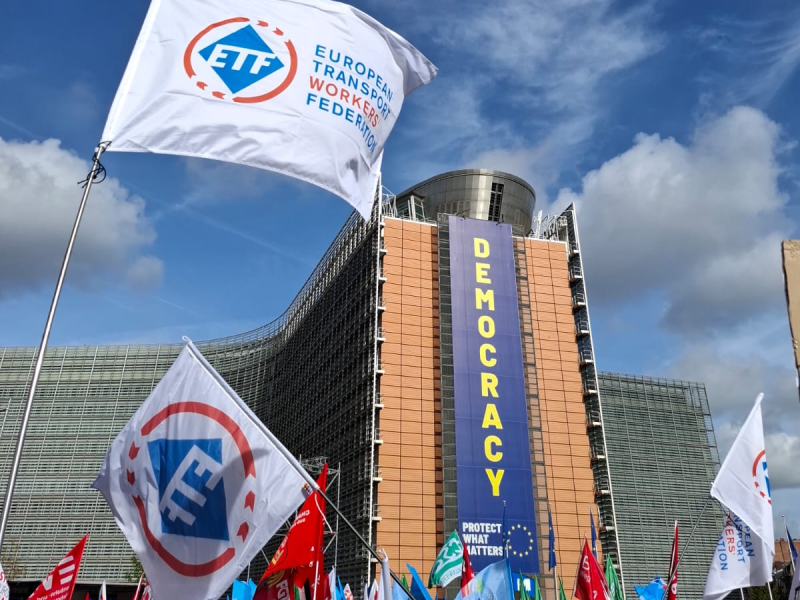
IRU and ETF delivered their joint statement on third-country drivers to the EU Jobs and Social Rights Commissioner today. Both organisations commit to working together to enhance the working conditions of third-country drivers, in full respect of their rights.
Europe’s road transport social partners, IRU and ETF, today signed and handed over their road transport social partners joint declaration on creating a European framework to improve the working conditions of third-country drivers employed by EU-based companies to EU Jobs and Social Rights Commissioner Nicolas Schmit.
The two organisations expressed their commitment to make the driver profession more attractive, emphasising the inclusion of EU youth and women, and improving the working conditions of third-country drivers. This includes the recognition of their qualifications and licences, in full adherence with EU and national regulations.
Acknowledging the critical role of road transport to resilience, mobility networks, and supply chains, the joint statement underlines the sector’s indispensable contribution to the economy and its role as a pivotal job creator. It also addresses the growing challenge of professional driver shortages.
EU Jobs and Social Rights Commissioner Nicolas Schmit said, “The joint ETF-IRU statement is an important step in addressing labour and skills shortages in the road transport sector. It is a demonstration of the European sectoral social partners’ commitment to take action to improve working conditions for non-EU drivers.
“Abusive practices and poor working conditions have no place in the EU. I strongly welcome today’s statement which should be an inspiration for other sectors,” he added.
ETF General Secretary Livia Spera said, “This statement marks an important first step towards committing both social partners and European institutions to tackling the underlying issues of the road transport sector. Key elements highlighted in the statement, including wage calculation, social security violations, and better enforcement, are pivotal for raising industry standards, in a context of deteriorating working conditions.”
“We hope that the new working group will foster the development of more concrete and targeted proposals from social partners,” she added.
IRU EU Advocacy Director Raluca Marian said, “This joint statement by Europe’s road transport social partners represents a milestone in our collaborative efforts to address the challenges, including driver shortages, facing the road transport sector while placing the emphasis on making the profession open and attractive to all.”
“Our focus first and foremost is to attract more local talent to the driver profession, including young people and women. However, given the extent of the shortage, third-country drivers are necessary. We warmly welcome Commissioner Schmit’s support in ensuring a positive driver experience and finding solutions to support the harmonious application of EU transport rules,” she added.
“All road transport operators must abide by the rule of law. Any infringements or illegal activity must be sanctioned by the relevant enforcement authorities. IRU condemns cases and practices of mistreatment and discrimination against third-country drivers, such as the ones witnessed at the Gräfenhausen-West parking area in Germany in 2023, and similar recent cases,” concluded Raluca Marian.
IRU and ETF have created a joint working group to address issues of common interest, such as advocating for a sector-wide commitment to legal compliance, especially concerning working conditions and driver pay. They stressed the importance of enforcing the EU’s Mobility Package 1, tackling abuses, and promoting targeted controls to ensure fair treatment across the board.
The joint statement also addresses potential standards and frameworks for social sustainability and due diligence in driver welfare, aiming to prevent human and labour rights violations within the sector.
Furthermore, the social partners call upon the European Commission and Member States to support their initiative, including by developing tools for calculating driver remunerations, committing to a targeted enforcement of rules, and improving parking and rest facilities for drivers.
The joint statement calls on all actors, public and private, to recognise professional drivers as essential workers and to ensure their respect and support across the industry.
It underscores their collective responsibility to implement the Corporate Sustainability Due Diligence Directive and promote a sustainable, inclusive and fair road transport sector.