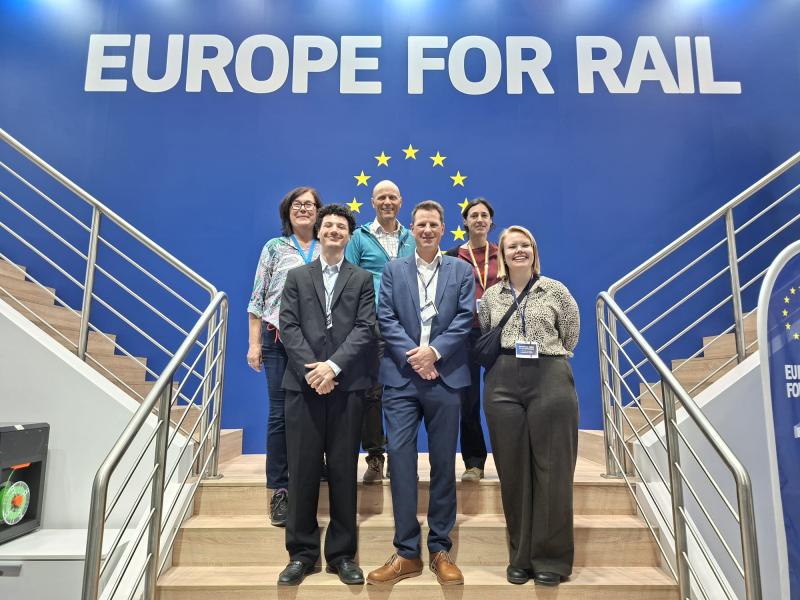
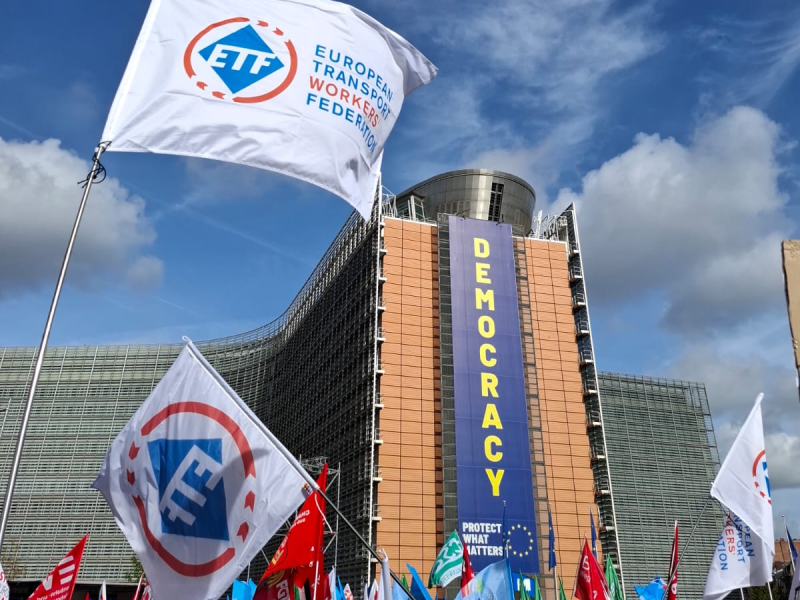
The European Transport Workers’ Federation (ETF), its affiliates, and a significant delegation of ETF railway workers have united with the European Trade Union Confederation (ETUC) in a march to the European institutions in Brussels. Their purpose is to voice strong opposition to plans for the commencement of the austerity 2.0 program slated for the upcoming year.
The ETF railway workers have a pressing message for the European Commission: they call upon the Commission to proactively stimulate the revitalization of rail freight transport throughout Europe. This call includes advocating for increased public investments and declaring rail freight as a service of public interest.
Rail freight transport is a beacon of environmental sustainability, emitting 9 times less CO2 than road transport for the same cargo quantities. Each freight train in Europe effectively replaces over 50 trucks on the road, making rail freight one of the most environmentally friendly means of goods transportation. This plays a pivotal role in achieving the ambitious objectives of the Green Deal.
However, despite the European Commission’s aim to double the modal share of rail freight by 2050, the current modal share of rail in European freight transport stands at an all-time low of 11.5% in 2020 since the sector was liberalized in 2006.
Complicating matters further, the European Commission is conducting investigations into two of Europe’s largest rail freight operators, DB Cargo and SNCF Fret, for allegedly receiving illegal state aid. In response, these companies are formulating restructuring plans that could have dire consequences for the climate, the sector, and its workforce.
In Germany, DB Cargo’s plans foresee the loss of 1800 jobs, potentially adding 40,000 additional trucks to the roads daily if the single-wagon load disappears. Meanwhile, in France, SNCF and the French state’s proposals for the ‘discontinuity’ of SNCF Fret could lead to a 20% reduction in traffic without clear alternatives for its absorption, accompanied by the loss of 500 jobs.
The ramifications of such restructuring would be profound, risking a reverse modal shift from rail to road. This shift is driven by the misguided belief that increased competition will enhance rail freight despite contrary evidence spanning the past two decades.
The ETF unequivocally demands that the European Commission halt its investigations into these companies and instead designate rail freight as a service of general interest. Policymakers must acknowledge the holistic benefits rail freight provides, not only to the economy but also to the climate, environment, and society at large.
With its inherent economies of scale and extensive integrated network with cross-border cooperation, rail freight should be actively supported and encouraged through robust policies. Instead of promoting austerity measures and penalizing authorities for investing in this eco-friendly mode of transport, the European Commission should spearhead policies that incentivize investments in rail freight.