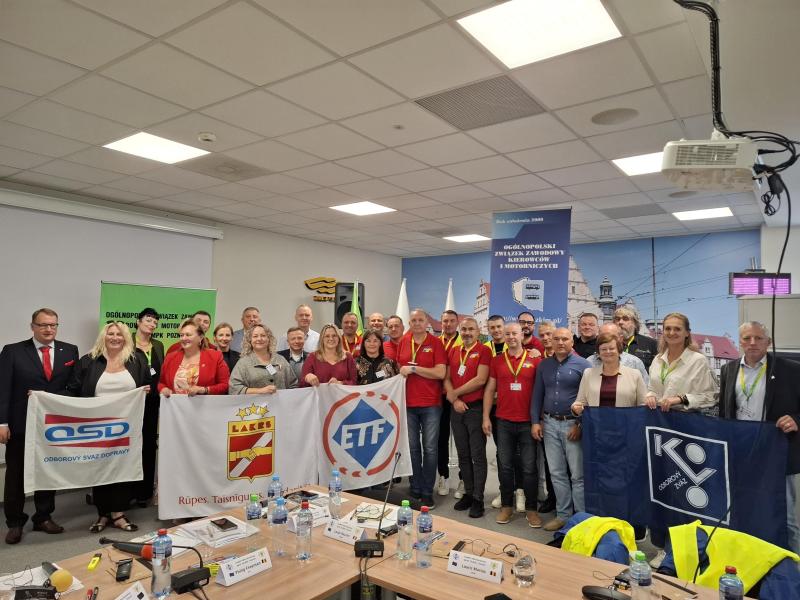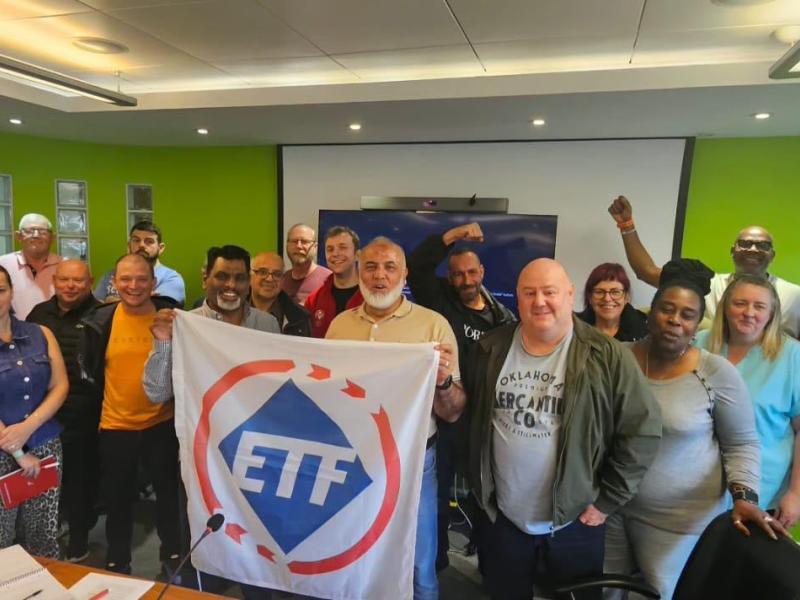


Today the European Transport Workers’ Federation (ETF), gathering over 270,000 workers across the whole aviation industry, presented its 10 key priorities for the revision of the “Basic Regulation” which sets the framework and competences of the European Aviation Safety Agency (EASA) to the key decision-makers from the European Commission, the European Parliament (EP) and the Agency itself.
The ETF has been involved in the revision process since the very beginning and has contributed to both the public consultation of the Commission and of EASA. ETF members have intervened vis-à-vis the EP TRAN Committee and Member States on ETF’s key priorities.
ETF’s first priority remains the interdependence between safety and socio-economic factors. Evidence shows that there is a strong interaction between some safety rules developed by EASA and social conditions, as well as health & safety at work. Anu Hietala and Oliver Richardson, ETF Civil Aviation Section Co-Presidents, commented: “We welcome the TRAN Committee’s proposal for a new article that mandates EASA to address the interdependencies between safety and socio-economic factors. In line with the European Commission’s commitment for a more social Europe, there is also a need for reinforcing the social partners’ consultation. In addition, ETF is opposing the ‘uberisation’ of aviation via the development of unregulated public flight cost sharing”.
In the framework of the inclusion of ground handling into the scope of EASA, ETF requests certification and standardised training for ground staff. It is also necessary to establish a full licensing scheme for cabin crews who are the primary care providers in emergency situations. ETF remains very reserved towards the proposed mechanism of transfer of responsibilities because it risks creating loopholes and enables operators to escape from jurisdiction of stricter national aviation authorities responsible for safety. Furthermore, ETF rejects the proposed extension of flexibility provisions from 2 to 8 months as this will have serious impact on the uniform application of the regulation and level playing field among the operators.
ETF reiterates its strong opposition to the introduction of minimum services in air traffic management. This issue has no safety relevance and only tries to impose limitations on strikes via the “back door”. François Ballestero, ETF Political Secretary for Civil Aviation, insisted: “The right to strike is one of the fundamental social rights guaranteed by the Treaties and its regulation is a prerogative of the individual Member States. Moreover, experience from countries where minimum services exist shows that they do not efficiently address the industrial actions“.
ETF thanks Marian-Jean Marinescu, Member of the European Parliament, rapporteur on this dossier, Filip Cornelis, Commission Aviation Director, and Luc Tytgat, EASA Strategy & Safety Management Director for their participation in the ETF seminar.
The full text of the 10 ETF priorities can be found here.
For more information, contact François Ballestero, ETF Political Secretary for Civil Aviation at f.ballestero@etf-europe.org; +32(0)474 916 979.