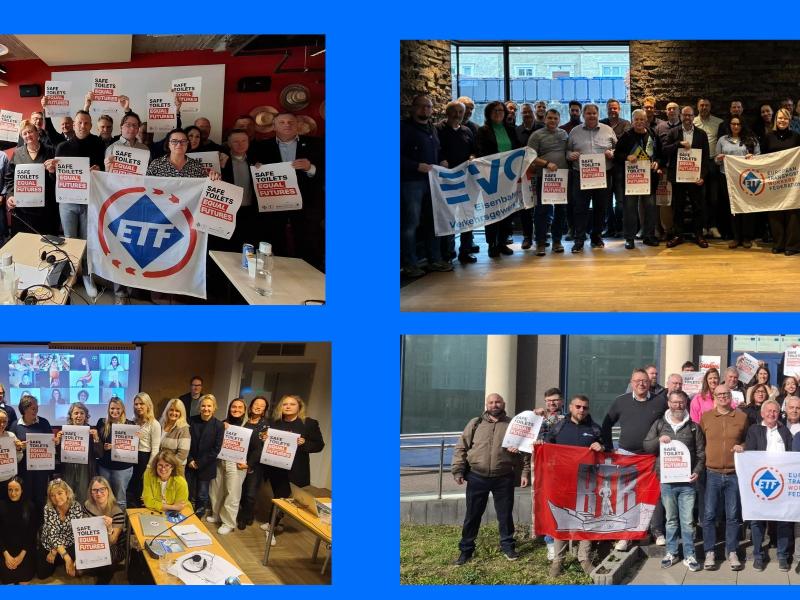


On World Toilet Day, 19 November, ETF – together with the ITF – demands what should be obvious: no transport worker should have to go without a clean and safe toilet.
For millions of professional drivers, including train drivers, a basic need becomes a daily problem. On Europe’s roads, truck, bus and coach drivers struggle to find clean toilets, showers and washing facilities during their journeys. One of the root causes is a severe shortage of parking areas: a 2025 European Commission study found that the EU is missing around 390,000 certified secure truck parking spaces.
In urban public transport and on the railways, the situation is no better. Many terminus points have no toilets at all, and train drivers often cannot use the ones that exist, because employers do not provide them or because drivers are not given enough break time. Unrealistic schedules, overwork and understaffing leave drivers no time to look for one, so some cut down on drinking water to avoid the problem, while others look for a quiet corner by the roadside. Cutting down on water is not harmless: research from Loughborough University shows that driving while dehydrated can be as bad as driving drunk, which puts other road users at risk too. Employers are responsible for providing sanitary facilities, but it is public authorities and cities that can build them, and too often nobody takes responsibility. And drivers who cannot take regular comfort breaks are more exposed to urinary tract infections, kidney problems and long-term bladder issues. For menstruating train drivers, there is the added risk of toxic shock syndrome.
For women transport workers, the situation is even worse. This year’s World Toilet Day is dedicated to sanitation and gender equality, and the link is painfully concrete. Women have fewer acceptable alternatives and additional needs, including menstrual hygiene. A roadside bush is unpleasant for anyone, but it can be dangerous for a woman driver on an early morning or late shift. Lack of privacy and safety concerns make the job harder and less attractive for women, who are only 4% of truck drivers and 16% of bus and coach drivers. The lack of access to sanitation is one of the barriers for women to enter or to stay in the transport sector. Poor facilities also fuel driver fatigue, because everyone needs safe places to stop, wash and rest.
It does not have to be this way. In Poland, national law guarantees public transport workers access to toilets, with set standards and intervals and heavy fines for cities and operators that fail to comply. As a result, 95% of local governments have built the necessary facilities. What works in Poland can work across Europe.
To make it happen, ETF demands:
- More safe and secure parking areas with proper toilets, showers and washing facilities, backed by investment from the EU and Member States.
- No price tag on dignity. Employers must cover the costs of access to parking and sanitary facilities where needed.
- Binding rules. Access to toilets at terminus points, depots, stations and along routes must be set in law, with clear standards, realistic schedules with adequate break times built in and real responsibility for authorities and operators, subcontractors included.
- Facilities that work for women, guaranteeing privacy, safety and hygiene.
This is a battle ETF has been fighting for a long time. It has campaigned on driver fatigue since its 2021 EU-wide report, and every 21 June it marks the European Day Against Driver Fatigue. Its Road Section regularly visits parking areas to hear directly from drivers about their working conditions. This year, the Railways Section, the Road Section, the UPT Section, and the Women’s Committee joined the ITF campaign with group photos. Safe toilets are a matter of health, safety and equality, and workers cannot wait.