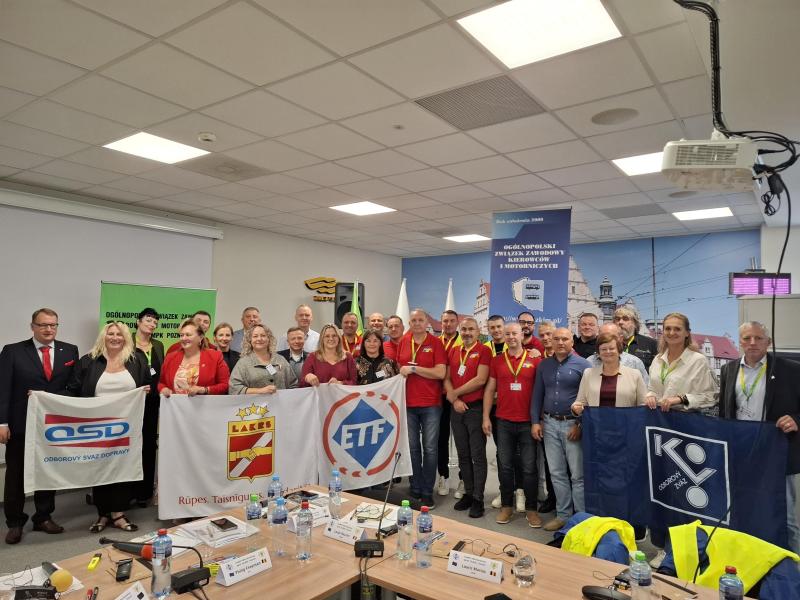


Tomorrow, 10 October 2013, the ETF Road Transport Section goes on action once again and calls for the European Institutions and the Member States to enforce existing social and road transport legislation in the European Union. It is unacceptable that, for instance, letter box companies are expanding in Europe although they are illegal since 2011, according to EU Regulation (EC) No. 1071/2009. Meanwhile, they remain at the core of illegal employment practices, social dumping and modern slavery in the sector.
ETF action day, part of “Respect for professional drivers” campaign
As part of the ITF International Week of Action for Road Transport, and of the long-term ETF campaign on working and living conditions of professional drivers, the ETF Road Transport Section and its members will organise a centralised action in Brussels, as well as decentralised actions in various European countries. In Brussels, a group of trade union representatives will distribute leaflets in front of the European Commission building, Berlaymont, signalling the issue of social dumping and poor enforcement in road transport. In other European countries, ETF Road Transport Section members will address open messages to law-enforcement government authorities, and will organise actions such as leafleting and picketing.
Social dumping in road transport is common practice
In Europe, free movement of labour in road transport regrettably translates into recruiting professional drivers from EU Member States with lower pay, labour and social standards, to then dispatch them to other European countries from where they work according to the pay and conditions of their country of origin, which is illegal! This group, of so called non-resident drivers, is the most vulnerable one in the sector. Living in their lorries for weeks, away from home, with no access to hot meals and sanitary facilities, they depend entirely on their precarious employment situation. Social dumping in road transport has led to considerable distortion on the EU labour market, putting at risk the fair competition in the sector and the safety on European roads.
Member States and EU Institutions have the right EU legal instruments to end social dumping in road transport
The above described situation can only be stopped through the proper enforcement of existing EU regulations and directive such as:
- Regulation (EC) No. 1071/2009 on access to occupation, which includes provisions to eliminate the letter-box companies;
- Regulation (EC) No. 561/2006 on driving and rest time;
- Regulation (EC) No. 1072/2009 including cabotage rules;
- Regulation (EC) 593/2008 (the so called ‘Rome I Regulation’) entitling professional drivers to the pay levels and working conditions of the host country irrespective of their nationality;
- Directive 2002/15/EC on working time for mobile personnel;
- Directive 96/71/EC on posting of workers entitling professional drivers to pay levels, working and social conditions of the host country when performing cabotage operations.
Despite the huge potential of these rules to address social dumping and modern slavery in road transport, Member States and the European Commission seriously lag behind in terms of enforcement. To this end, the letter box company phenomenon is a typical example.
The ETF Road Transport Section claims once again “Respect for professional drivers”. The future of our sector is in the hands of the EU Institutions and the EU Member States.