

The European Trade Union Confederation (ETUC) held a conference in Rome on 24 October 2019 to present the outcomes of the EU-funded REBALANCE project on trade unions’ and social partners’ actions to improve reconciliation of work, family and private life for women and men. The ETF was – amongst other European trade union federations and national confederations – a member of the project’s Steering Committee.
Two publications were disseminated during the conference:
- ETUC study on trade union strategies and good practices to tackle work-life balance issues in collective bargaining.
- ETUC toolkit on the implementation and transposition of the EU work-life balance directive.
The study provides an overview of best practices on work-life balance agreements negotiated by social partners in 10 EU Member States: Finland, France, Germany, Italy, Lithuania, Netherlands, Portugal, Slovenia, Spain, and Sweden. The research focuses on measures that enable parents and other carers to reconcile work, family and private life, through the introduction of family and parental leave schemes, care arrangements, and the development of a working environment which facilitates the combination of work, family and private life for women and men.
 The toolkit gives a clear indication of how the recently adopted EU work-life balance directive must be implemented and transposed by EU member states. The directive will be crucial in further improving work-life balance in a good number of member states. However, the directive must be properly transposed into national legislation and then be implemented. The deadline for the Member States to transpose the directive is June 2022. To further support the work of ETUC’s member organisations on better work-life balance at national level, the toolkit provides a collection of tools, guidance, and resources on the following issues:
- What are the main elements of the new work-life balance directive?
- What role do trade unions play in the transposition of the directive?
- What actions may be required to transpose the directive?
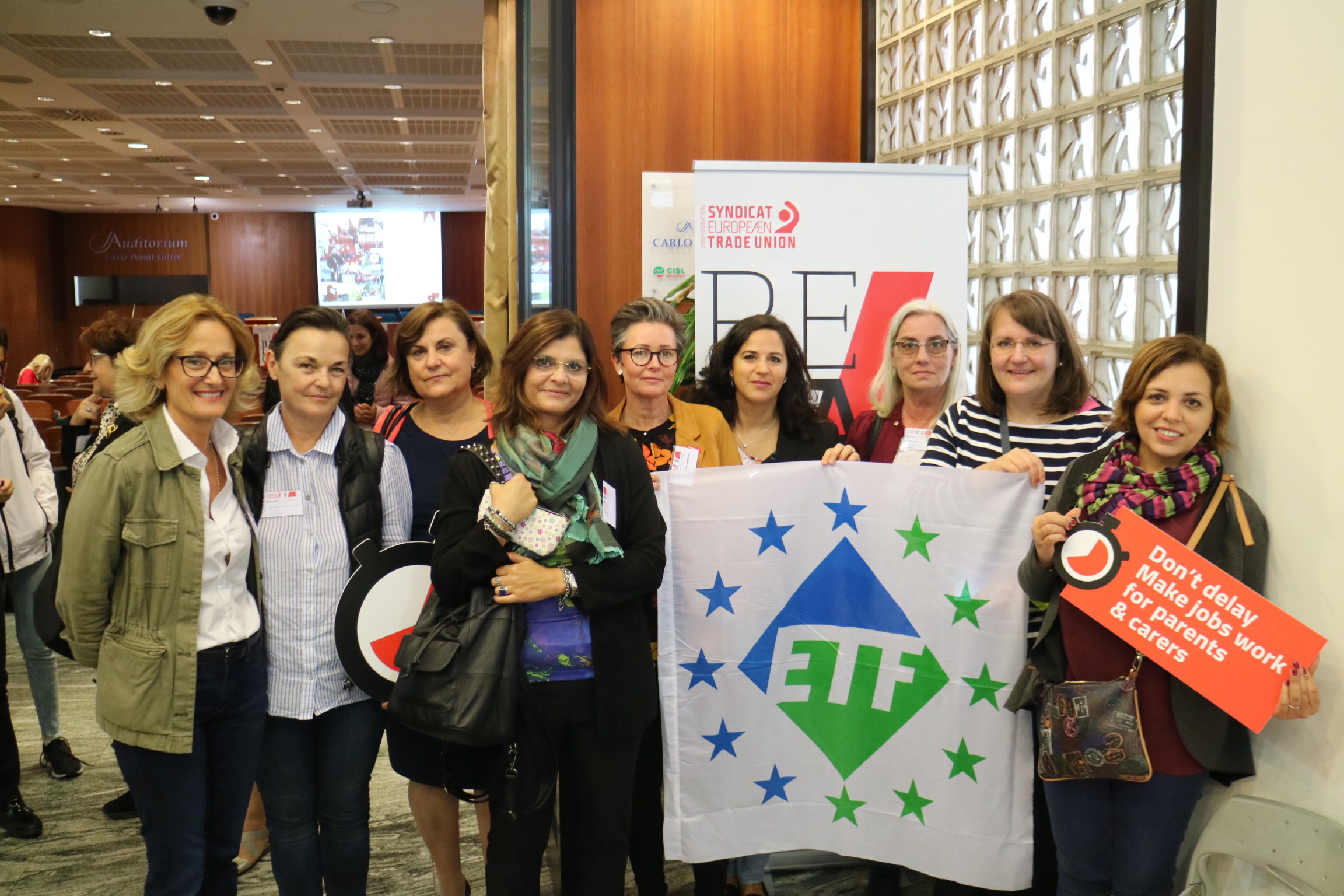
The ETF was represented at the conference by a delegation of women trade union representatives from ACV Transcom (Belgium), FILT-CGIL (Italy), FIT-CISL (Italy), FTTUB (Bulgaria), Kommunal (Sweden) and Uiltrasporti (Italy). The ETF delegation expressed its support for a swift implementation and transposition of the EU work-life balance directive.
The ETUC study and the toolkit (in EN, FR, DE, IT, ES) can be downloaded from the ETUC website: https://www.etuc.org/en/publication/rebalance-trade-unions-strategies-and-good-practices-promote-work-life-balance