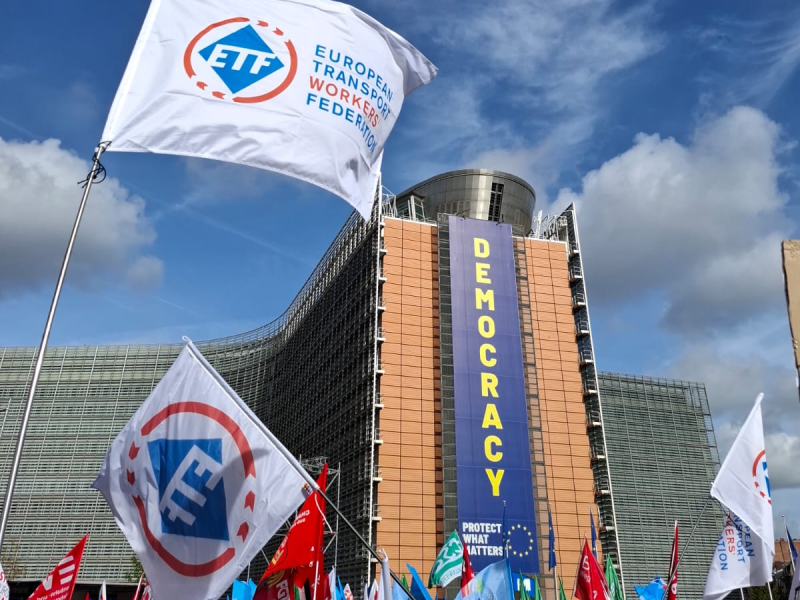


Last week, Finland witnessed a significant moment in its labour movement history as thousands of workers took to the streets in a powerful demonstration against proposed government cuts. On February 1 and 2, the Finnish capital, Helsinki, became the epicentre of a massive mobilisation led by the trade union confederations SAK and STTK under the banner “STOP Now!” This nationwide protest was a direct response to the right-wing government’s plans to implement cuts in working life policies and social security, sparking widespread concern among the workforce.
The political strikes saw a remarkable unity among various labour sectors, with several transport unions standing in solidarity, including affiliates of the ETF. These strikes were not aimed at employers but at influencing political decisions, highlighting a collective call for the government to abandon its cutback plans and engage in genuine dialogue with worker representatives.
More than 13,000 demonstrators gathered in Helsinki on February 1, voicing their opposition to the government’s disregard for union negotiation. Labor Minister Arto Satonen’s refusal to open discussions was met with vocal protests, underscoring the deepening rift between the government and the labour force.
The stakes were raised with the impending submission of two government projects to parliament: a draft law on “industrial peace” and a draft law on local agreements. Both proposals have been met with scepticism and distress from the unions, concerned that these changes would erode trade union rights, disrupt decades of contractual agreements, and facilitate employers’ bypassing of collective bargaining agreements.
Amidst this backdrop, the transport sector played a pivotal role in the protests, with the entire aviation industry in Finland coming to a halt. Unions representing a wide range of workers, from ground handling staff to cabin crew and railway workers, organised strikes that significantly impacted rail and air travel, signalling their dissatisfaction.
Ismo Kokko, president of AKT and the Nordic Transport Workers’ Federation NTF, articulated the workers’ sentiment, emphasising the need for the government to heed the workers’ demands. The broad participation across sectors, including trucking, buses, ports, and even the largest strike in the history of the Trade Union Erto, exemplified the collective resolve to defend the Nordic model of negotiation-based labour relations.
As Finland faces these critical changes, the labour movement’s strong response highlights a pivotal moment in the struggle for workers’ rights and social justice. The call for dialogue remains loud and clear, hoping a constructive resolution can be reached to avert further escalation and preserve the Nordic labour model.