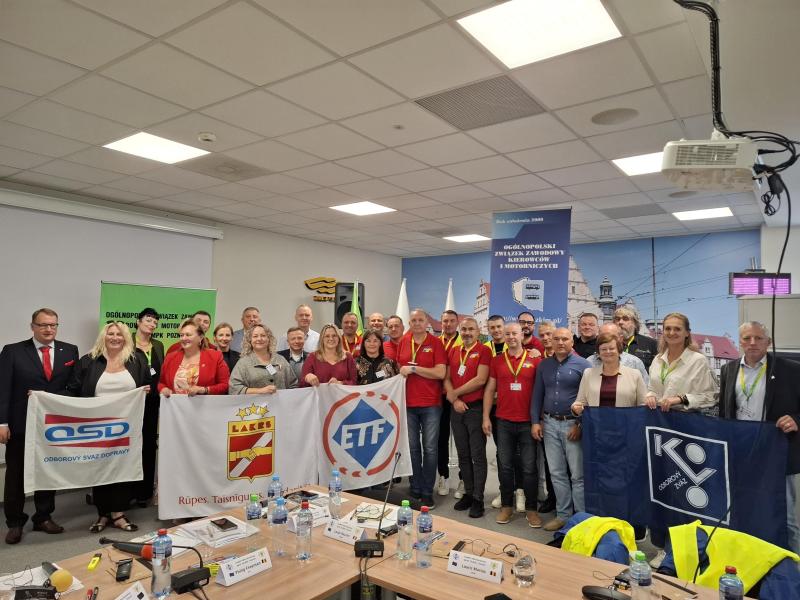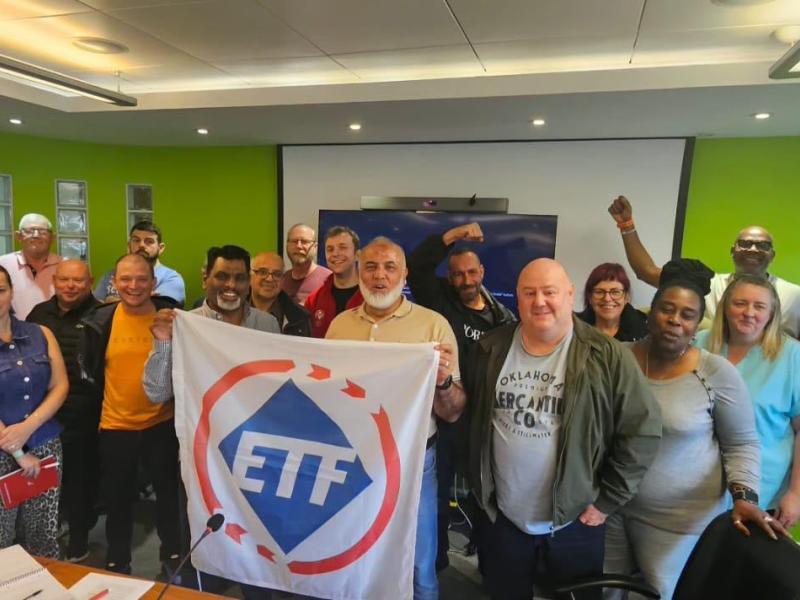


A united front of French trade unions is holding firm in its innovative 3-month strike against President Macron’s rail reforms. The European Transport Workers’ Federation (ETF) supports their struggle for fair transport and a quality public rail service.
This is not an evidence-based reform to improve a public service; it is an ideological liberalisation in the same vein as the EU’s 4th Railway Package. Similar reforms in other countries have not improved service or value-for-money. European Commission research shows that passengers in Germany and the UK, which have more liberalised rail markets than France, pay consistently more per kilometer than French passengers.
Macron’s government insist they are not privatising SNCF, but the change from a public-service company to a state-owned private company is the first step. Combined with European laws driving greater competition, this change will leave a weaker SNCF more at risk of break-up. SNCF might continue to exist as a publicly-owned company, but competitors and SNCF subsidiaries behaving like private companies will increasingly deliver the services.
And what about SNCF workers? Staff costs are blamed for the SNCF’s huge debt burden. But the debt is largely due to the borrowing that financed construction of high-speed TGV lines. Changing workers’ contracts will do little to reduce SNCF’s debt. However, abolishing the “statut des cheminots” contracts for new SNCF employees will create a two-tier workforce. Young workers will face lower working conditions in the same company. That will create frustration and demotivation – counterproductive for the SNCF, which already has huge problems attracting enough staff.
What is more, when services shift to other operators existing staff’s contracts are also under threat. This could put SNCF workers in a similar position as Swedish colleagues, who were transferred to a private operator and forced to reapply for their own jobs under worse conditions. Indeed, some workers have already been taken off SNCF-wide contracts, as we see on the T11 suburban rail service in Paris operated by the SNCF subsidiary Kéolis. It seems SNCF employees are right to be worried.
ETF Rail Section President Giorgio Tuti sent a message of support: “French rail workers are not only defending themselves. They are fighting for the principle that rail should be a public service, not a product sold according to market logic. International comparisons show that a liberal agenda simply does not work for the rail sector. We need proper investment and coherent planning, not privatisation by stealth. The ETF strongly supports this action against Macron’s attack on the French railways. Workers across Europe thank French colleagues for stepping up to defend the quality and values of public service railway.”
The loss of SNCF as a true public service railway would be a tragedy for France and Europe. The French people should have pride in the history and quality of their rail service, and the rush to donate to strike funds implies they already do. With proper investment and the application of high environmental and social standards – which are permitted under European law – a strong, public SNCF can be protected from unfair competition.
The ETF’s Fair Transport campaign is all about transport workers across Europe standing together to defend decent work and quality service in the transport sector. Ideological liberalisation and unfair competition cannot go unopposed. French railway workers can be sure that allies across Europe are beside them in their struggle.
For more information and interviews with workers and union experts contact:
Bryn Watkins, European Transport Workers’ Federation
+32 470 93 05 90
The European Transport Workers’ Federation (ETF) embraces transport trade unions from the European Union, the European Economic Area and Central and Eastern European countries. The ETF represents more than 5 million transport workers from more than 230 transport unions and 42 European countries
Additional Reading:
A recent EU Court of Auditors report rejected the entire idea of Public-Private Partnerships, saying that they “cannot be regarded as an economically viable option for delivering public infrastructure”.
Many towns across Europe have started to “remunicipalise” public services, ending private contracts and delivering them directly to improve quality and efficiency.