Workers are at the heart of the green transition of the European aviation sector, and they insist on a socially responsible transition with real investment in both technology and the workforce; this was the main takeaway at the second aviation roundtable organised by industriAll Europe and the ETF, as part of their joint EU project Building a Just Transition towards a Smart and Sustainable Mobility (JT4 Mobility).
From producing the much-needed sustainable aviation fuels (SAFs) to building engines that use cleaner fuels to more sustainable operating of aircraft, it is clear that a strong and qualified workforce in the aviation industry is of vital importance. It is impossible to discuss green technology without carefully examining how it will be produced and used by workers in Europe.
The first panel explored the opportunities and challenges of sustainable aviation fuels (SAFs), which is receiving increased focus at the EU level. Interventions from Safran, Airlines for Europe, and Transport and Environment focused on the positives of SAFs, from lower CO2 emissions to better air quality, but that there was an urgent need for a huge increase in both production and the uptake of SAFs for important decarbonisation targets to be met. Speakers called for concrete support at Member State and EU level, which must be safe for workers and passengers as well as not causing any harm to the environment, neither by causing food shortages nor deforestation.
Isabelle Barthes, Deputy General Secretary of industriAll Europe, said:
‘’While electrification and hydrogen are important long-term options for some flights in the future, we know that sustainable aviation fuels can be used now in most modern engines. With increasing pressure to green the aviation sector, trade unions call for urgent action to vastly increase both European SAF production and the uptake of these fuels for European flights while continuing to improve energy efficiency via smart design and new green technology thanks to an incredibly skilled European workforce.’’
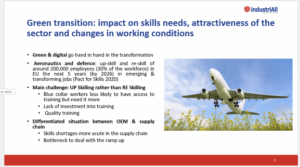
The second panel focused on the potential impact of the green transition on manufacturing and transport workers in the European aviation sector. Rolls-Royce presented their work at the company level on skills development to help attract and retain workers, and the European Commission stressed that the green and digital transition needs to be managed in a socially responsible way and that skills are key in the sector, noting that 2023 will be the European Year of Skills.
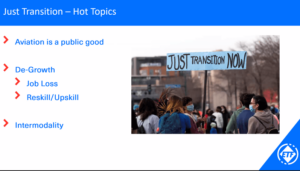
IndustriAll Europe and ETF stressed the need to find sustainable solutions to address the current skills shortages while also ensuring a safe transition towards green jobs. They must be adequately tackled as opposed to relying on labour migration which can lead to brain drain in some regions. The main factor in attracting and retaining the workforce is offering quality jobs with fair pay. And there is no other way but to place workers at the core of the green transition. This process also needs to foster dialogue and cooperation, with proper engagement with workers and local representatives that should start with establishing Just Transition Committees as a key condition to a socially managed transition.
Sabine Trier, Deputy General Secretary of ETF, said:
“Transport workers are at the front line of the green transition, but- they must not be the ones to pay the costs. Aviation hasn’t fully recovered yet from the COVID-19 pandemic, which saw mass layoffs and continues to suffer from high turnover. The green transition must go hand in hand with a transition to better working conditions and solid investments in up-skilling and re-skilling, as it is crucial to support our transport workers to be ready for green jobs, for the jobs of the future.’’
In the following months, industriAll Europe and ETF, with the support of SPIN 360, will collect evidence and analyse the different trends, challenges and opportunities for each transport mode and will identify concrete recommendations and best practices on how to achieve a Just Transition in the mobility ecosystem.
The JT4MOBILITY project brings together vehicle manufacturing and transport service workers to address the social consequences of the decarbonisation of the transport system and pathways towards a Just Transition for the workforce. The project wants specifically to map the impact on the three macro areas of employment, skills and working conditions to cover the effects of decarbonisation, the expected modal shift that European policies aim to reach, but also the new transport needs that will emerge from the new industrial policy.”