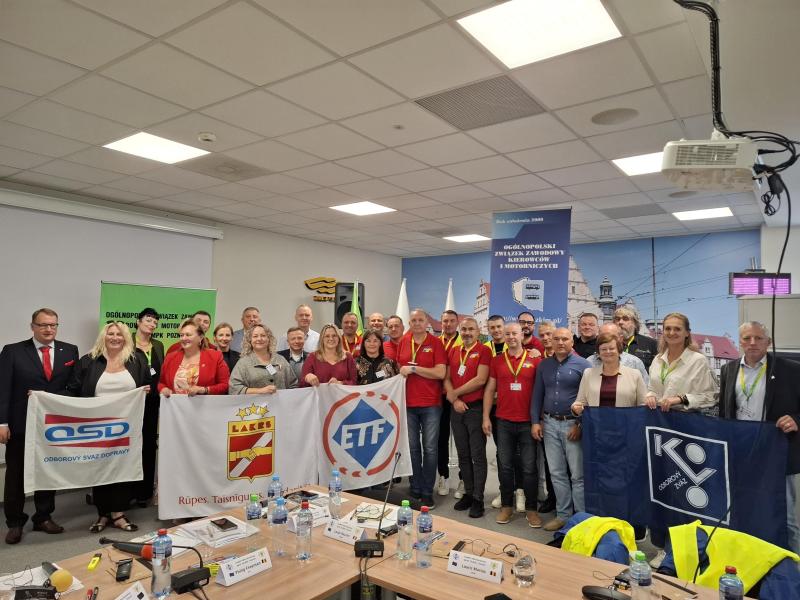
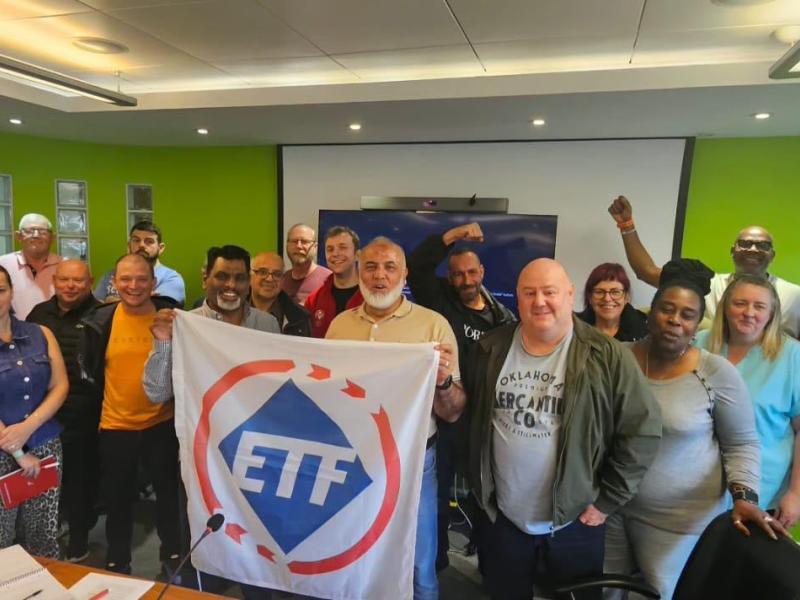
Third European roundtable on a Just Transition for the aviation sector with manufacturing and transport trade unions standing in solidarity against attacks on working conditions and jobs.
Aviation trade unions representing manufacturing and transport workers met last week in Charleroi, an important European hub for aviation, to dive deeper into the realities of the green and digital transitions for the workforce and to identify concrete recommendations and tools to ensure that the transitions are socially responsible.
Trade unions from across Europe raised the decarbonisation challenges facing the aviation sector, from access to clean fuels and large-scale investment in new technologies to attracting and retaining workers. Participants stressed that only by including aviation workers in the analysis, planning and implementation of the green transition can the sector deliver decent jobs in the future: good quality, well-paid jobs and good working conditions.
Participants heard from the chair of Safran’s European Work Council, who outlined a recent European Framework Agreement on skills between industriAll Europe and the company as an example of best practice in identifying skills needs with trade union representatives. Notably, the agreement provides for a jobs and skills observatory and establishes a skills development interview and individual training right for every worker, which was pushed by the trade unions. This landmark agreement provided a blueprint for participants to take to other companies in the aviation sector to improve skills analysis, planning and implementation of upskilling and reskilling at the company level with trade union involvement.
Isabelle Barthès, Deputy General Secretary of industriAll Europe, said:
” Trade unions must be at the forefront of the decarbonisation agenda to ensure that the green and digital transformation leads to quality jobs. The decarbonisation agenda must go hand in hand with the creation of well-paid, quality jobs with good terms and conditions. This is a precondition for industries to attract and retain skilled workers and to prepare for the future. There will be no Just Transition without the involvement of workers’ representatives on the ground or without a dedicated and skilled workforce!”
A concrete example of skills and job matching in the aviation sector was presented by Forem, the Belgian Public Employment Services. As well as being in regular contact with employers in the industry to gather information on skills needs and job opportunities, Forem has also established a strategic committee with both employers and trade unions. Engaging with both social partners has proved extremely useful in identifying bottlenecks and skills mismatches. The creation of the Walloon aero training network was also presented as an example of best practice that could be replicated in other aviation hubs across Europe.
Sabine Trier, Deputy General Secretary of ETF, said:
“A Just Transition in aviation should aim to ensure a balance between environmental and social sustainability. Aviation workers are ready to play their part in the industry’s ambitious goal of achieving environmental sustainability, but they cannot be the ones paying the price with their jobs, pay and working conditions. ETF’s perspective is straightforward: workers must be at the centre of all changes the industry must go through. Just Transition in the aviation sector must foster a work environment built on safety, just culture and democratic participation of workers.”
The green and digital transition will be particularly challenging for the supply chain, so participants were also able to visit Sonaca, a supplier of wings to both Airbus and Boeing. Trade union representatives from across Europe were able to see skilled manufacturing in action and speak to workers and shop stewards about their views on the future green and digital transitions. It was agreed that for the green and digital transitions to be a real success, the needs of an entire supply chain in Europe must be taken into consideration so that no worker or region is left behind.
——————————————————–
The JT4MOBILITY project brings together workers from the vehicle manufacturing and transport services sectors to address the social consequences of decarbonising the transport system and pathways towards a Just Transition for workers. Specifically, the project aims to map the impact on the three macro areas of employment, skills and working conditions to cover the effects of decarbonisation, the expected modal shift that European policies aim to achieve, but also the new transport needs that will emerge from the new industrial policy. The final conference in September will cover all mobility ecosystems: aviation, road, rail and maritime.