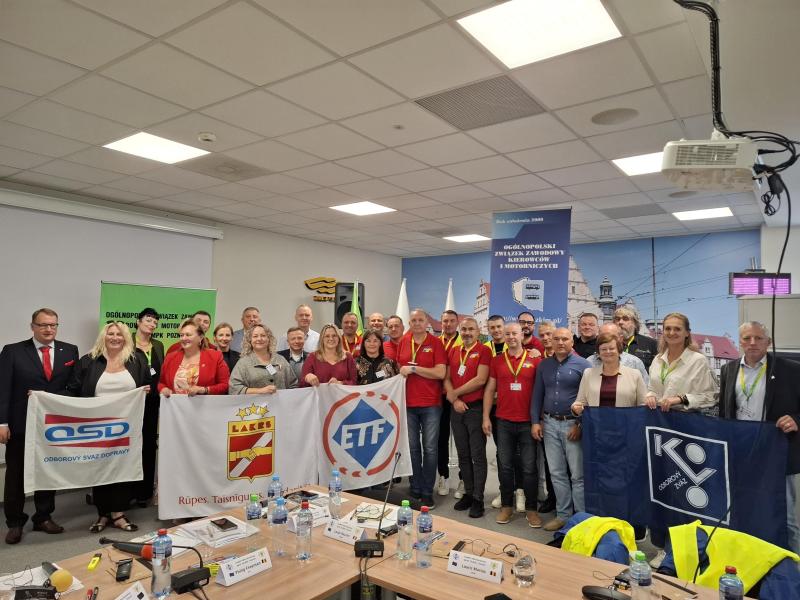


The social partners in urban public transport, ETF and UITP, the International Association of Public Transport, held the workshop Digital transformation in customer services and its impact on work in urban public transport last week in Vienna. The meeting gathered experts from trade unions as well as urban public transport (UPT) companies from across Europe.
Trade unionists and employers spent two days discussing the impact of digitalisation on the public transport sector. The following technological developments in customer services were identified as key issues:
- Ticket apps, e-tickets and contactless payments;
- Real-time passenger information;
- Mobility platforms;
- On-demand transport;
- Mobility as a Service (MaaS);
- WiFi and infotainment;
- Passenger data analysis.
During the workshop, examples of Mobility as a Service (MaaS) solutions were discussed. The meeting highlighted that the digitalisation of customer services will change the UPT sector very much. On the one hand, new solutions have a potential to contribute to better connectivity, especially for the last mile, but on the other hand, some passenger groups such as the vulnerable, elderly, disabled, or commuters in rural areas may not be able to fully benefit from these solutions. Trade unions highlighted that investments in urban public transport and strengthening the “traditional” UPT network density is of the utmost importance. Employees’ representatives also stressed that new business solutions for UPT shouldn’t happen at the expense of workers.
Nevertheless, the discussions showed that the emergence and growing popularity of on-demand transport may have an adverse impact on workers in UPT. Service according to demand can lead to changes in work schedules. For example, drivers may be required to work several shifts a day. In reality, this means that drivers working for on-demand services may find themselves under pressure to be at work 24/7 in order to make a living. This may lead to a significant safety risk for both drivers and other road users, and also presents a mental health risk for drivers exposed to never-ending pressure and stress. In addition, workers in UPT providing services through new mobility platforms are often treated as freelancers, and not regular employees. This practice of bogus self-employment puts workers in precarious situations and creates constant job insecurity as they are neither granted paid leave nor sick leave.
The exchanges between participants showed that there is much concern about working hours, working conditions, workers’ rights, data protection and privacy in today’s digital era. Discussions during the workshop focused on what the UPT social partners can do to accompany the digital transition to ensure that both companies and UPT workers benefit from the digital changes. Social dialogue was highlighted as an important tool to be used, not only on European but also at national level.
In terms of workers’ qualifications and job profiles in UPT, many changes are underway. Job descriptions are likely to keep changing with new technologies and social partners will have to play a significant role in defining the future of public transport and conditions for employment in it.
The workshop also served as an opportunity for participants to learn from concrete examples and explore new technologies and their functioning in UPT companies.
Participants also discussed differences between the effects of digitalisation on female and male employees. Trade union representatives pointed out that jobs that are usually done by women in UPT, such as issuing tickets or collecting fares on buses, were in many cases discontinued due to digitalisation. Moreover, the majority of customer service in UPT – as opposed to operations or maintenance – is predominantly female, therefore effects of digitalisation tend to impact women transport workers more than male workers.
The discussions during the workshop showed that there is potential for digitalisation to contribute to the creation of new job profiles that are very much customer oriented, be it a customer service at a physical desk or an online customer service support and communication. Participants agreed that social partners need to regularly exchange in order to identify ways for certain groups of employees to be trained for different tasks that differ from their current responsibilities while ensuring and improving working conditions. The role of trade unions is indispensable in these ongoing transformations, and we are committed and up to the challenge!
Pictures by Mylène Bianchy (Syprolux)