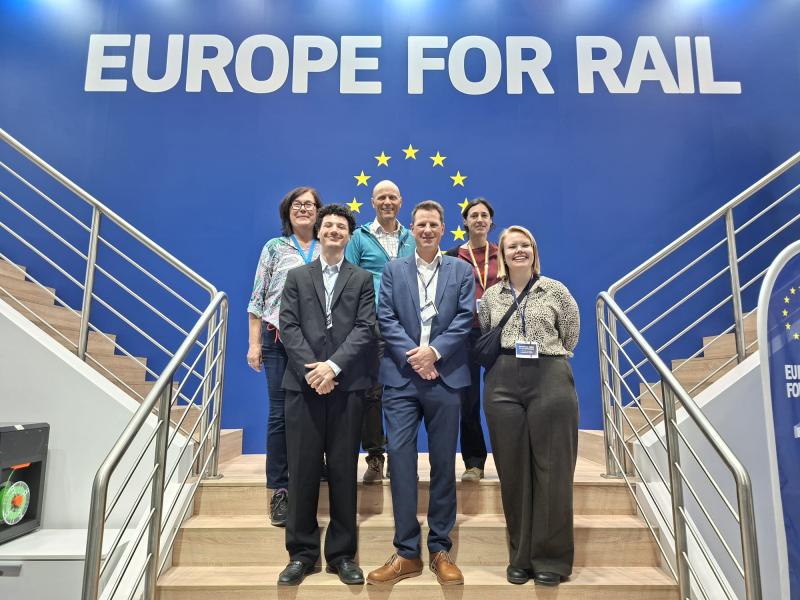
The ETF Railways Section just elected its new Chair, Gerhard Tauchner, to replace Giorgio Tuti, who has been elected as ETF President. In a powerful moment, trade union members thanked the previous Chair for his important work and elected new leadership to defend the future of railway workers at the European level.
We decided to interview the new Chair to understand his priorities for the following years.
Congratulations on your election! What motivated you to take on the role of Chair of the ETF Railways Section?
First of all, I would like to express my sincere thanks to our member unions for the trust they have placed in me. It is a great honour for me to work as Chair of the ETF Railways Section, together with my European trade union colleagues, on behalf of railway workers in Europe.
This opportunity is motivation enough to take on this position. We need a Europe of social equality, where no one is left behind, because only together we can achieve and defend good working conditions, good training, good wages and secure workplaces in Europe. I will continue to put all my energy toward this goal.
The rail sector is going through major changes – from liberalisation to digitalisation. What do you see as the biggest challenges and priorities for rail workers in the coming years?
Liberalisation has not helped either the sector or its workers. Now the much-praised competition is a reality, and what we always warned about has come to be: the pressure on workers has increased enormously, and the sector is struggling for its own stability. We are facing enormous tasks, and I can only mention a few of the biggest challenges here:
- Rail freight transport, and especially single-wagon load transport, is under enormous pressure. Thousands of employees are directly affected in their existence by the threat of job losses or those that have already occurred.
- In rail passenger transport, we will continue to campaign strongly for the continued use of direct award. Changing this well-functioning system would be extremely dangerous to the sector’s resilience. Contrary to the political dogma of the European Commission, namely towards intensive competitive tendering, direct award is still possible today, even after the revised regulation came into force.
- There is also an urgent need for the introduction of a tamper-proof, digital recording system for the working and rest times of train personnel. At present, we have no way to record and control hours worked on trains, especially in cross-border traffic, in a tamper-proof manner! This not only puts pressure on workers, but also puts railway operations at risk. We will not stop pushing for it: we need tamper-proof recording to guarantee fair and safe working conditions in Europe and to increase railway safety.
ETF and its affiliates have long fought to make rail an attractive and fair sector in which to work. How do you plan to strengthen trade union cooperation and ensure workers’ voices are heard in EU and national debates?
Together, we will continue to strengthen workers’ interests at the European level. Decisions made in Brussels have a direct impact on railway workers’ working conditions. Even now, the duration and content of workers’ training vary enormously. Lowering training standards or language requirements, rather than harmonising them at a high level across Europe, jeopardises not only good working conditions but also railway safety. We will maintain and expand our presence with the European Commission, the European Parliament and national governments to achieve improvements for our colleagues in all railway professions and for the sector.
Trade unions are experienced negotiators with a long-term approach, we know the sector from the inside, and the ETF is a recognised European social partner. I therefore expect that we will be consulted on political initiatives and legislation on an equal basis and that true involvement will finally become a reality.
Finally, how do you plan to engage younger workers and women in the rail sector and in union activity? Do you have a message for them?
The engagement of women and young people in the trade unions is an essential part of our strength. Our movement lives from young and committed colleagues who stand up for the interests of workers.
My message to young colleagues is: for me personally, trade union work across national borders has always been an enriching experience that broadens horizons and provides support. It is there to strengthen us and foster solidarity. Only together can we make the railway sector – nationally and across Europe – more social and fairer.