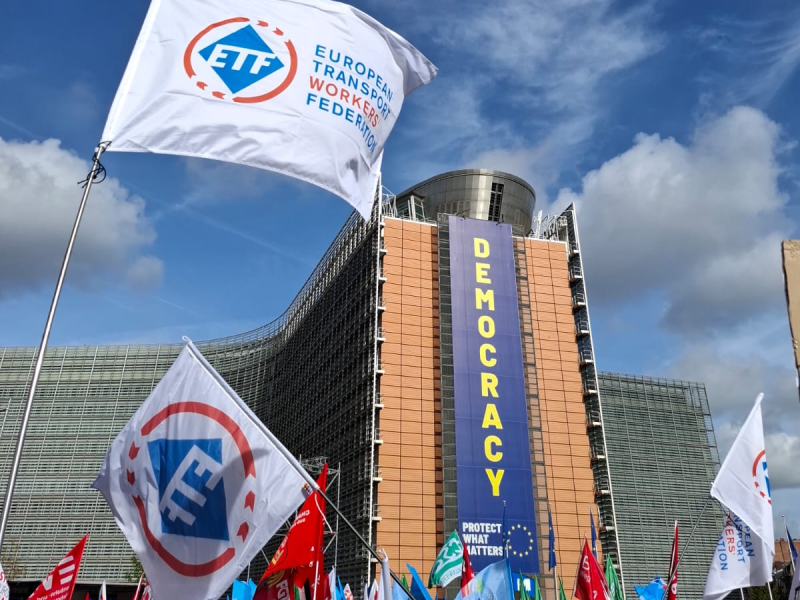


The International Transport Workers’ Federation (ITF) and the European Transport Workers’ Federation (ETF) defend the rights of striking aviation workers in Germany today (20 February) and support Ver.di’s calls for immediate and meaningful engagement on a new collective bargaining agreement, restoring wage cuts made during the Covid pandemic.
Ver.di called the strike due to management’s refusal to meaningfully engage with the union.
In an effort to achieve fairer wages and better working conditions for aviation employees, Ver.di has been negotiating for Lufthansa ground staff, for aviation security employees and for employees of Mitteldeutsche Flughafen AG.
The negotiations with Lufthansa involve almost 25,000 ground employees - including employees at counters, in aircraft handling and in cargo operations - who work in the individual group companies, such as Lufthansa AG, Lufthansa Technik or Lufthansa Cargo.
Ground staff across Lufthansa’s operations will be going on strike including Lufthansa Technik, cargo, and check- in staff. The locations affected by the striking Lufthansa employees are Frankfurt/Main, Munich, Hamburg, Berlin, Düsseldorf, Cologne-Bonn and Stuttgart.
The strike is expected to affect approximately 80% of Lufthansa's flights, impacting around 100,000 passengers.
Marvin Reschinsky, Ver.di negotiator, said “Despite record profits, Lufthansa is investing too little in staff.
“Ground workers once again feel insulted. While the group gives pilots high double-digit pay increases, ground workers with a starting hourly wage of 13 euros aren’t even getting cost of living increases to help cope with the price increases of the last few years. This is blatantly wrong.”
Livia Spera, General Secretary of the ETF, said "While airlines like Lufthansa rake in record profits, the ground staff who ensure their smooth operation are treated with disdain and offered wage increases that fail to keep pace with inflation. This is not just an injustice to these hardworking individuals but a threat to the entire industry's struggle with worker shortages. We stand in solidarity with Ver.di and urge Lufthansa and other employers to engage in meaningful negotiations that deliver fair wages and decent working conditions that keep the sector attractive to workers."
ITF’s Civil Aviation Secretary, Gabriel Mocho Rodriguez, said “The ITF stands with Ver.di to fight the unfair treatment of aviation ground staff and would like to remind the Lufthansa Group that the hard labour of their workforce is what allowed them to keep going all through the pandemic, and until now.”
Meanwhile, UPS Logistical workers who are members of the Ver.di union have begun their 24-hour strike action at the Cologne/Bonn airport.
Ver.di’s decision to call for a warning strike stems from the breakdown of ongoing negotiations and the failure of meaningful dialogue with the responsible employers’ associations on the bargaining of a new framework collective agreement for the transport and logistics industry in North-Rhine Westphalia.
The ITF’s Inland Transport Secretary, Noel Coard, said: “We strongly urge the responsible employers' associations to engage with Ver.di’s bargaining committee in good faith negotiations. The derogatory offers brought to the bargaining table by employers’ associations over the last two attempts to engage are a slap in the face to the workers that have worked hard to ensure the smooth running of operations, keeping this industry going over some of the most difficult times”.
Ver.di has outlined a list of demands in their negotiations, centred around the availability of full holiday pay, an increase in holiday days for members and the replacement of the existing collectively agreed regulations on overtime bonuses.
The employer however has presented a completely inadequate offer in both rounds of negotiations.