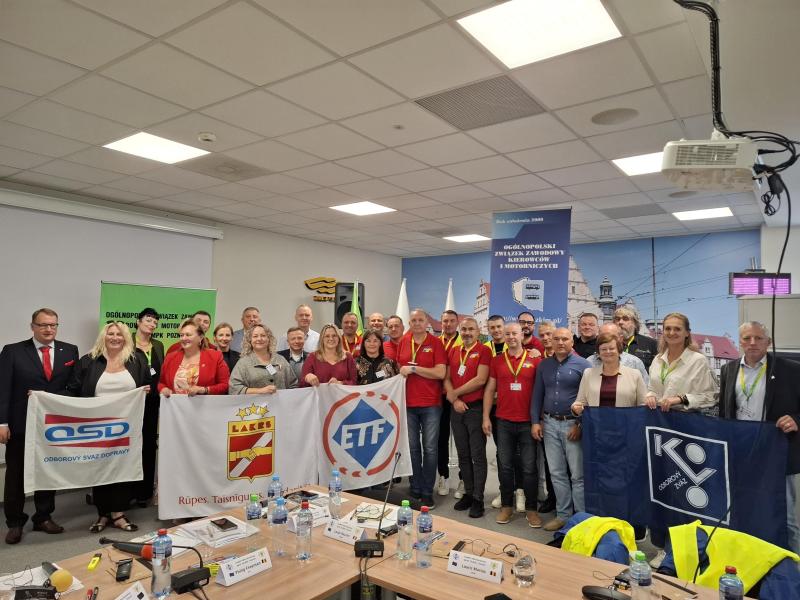
On 8 January 2014 IDC-E (International Dockworkers Council’s European zone) and ETF (European Transport Workers’ Federation) representatives met in Lisbon to discuss the alarming situation affecting Portuguese ports. The meeting was held following the decision to set up an international campaign and actions to protest against the port reform implemented in Portugal since 2012. As a consequence of this reform, the labour conditions at the Portuguese ports, and in particular at the port of Lisbon have progressively deteriorated. Both organisations agreed to start a joint solidarity campaign starting from January 2014.
The Portuguese conflict is a direct consequence of the devastating austerity measures imposed by the Troika (the European Commission, the European Central Bank and the International Monetary Fund) as a condition for the Portuguese government to obtain financial assistance. The European dock workers’ unions have repeatedly condemned these measures which are part of a larger labour deregulation process affecting European ports.
Amongst the major concerns of the unions there is the unwillingness of the employers’ organisations to enter into a meaningful dialogue with the unions. On the contrary, they continue to create an alternative labour pool of dock workers with the purpose of replacing union workers by an untrained non-union workforce. Since the entry into force of the new law, 47 dock workers employed at the port of Lisbon have been dismissed without cause.
The unions further condemn the fact that the new Portuguese port law is in breach of ILO Convention 137, which Portugal has ratified.
The solidarity campaign involves both political and lawful solidarity measures urging the Portuguese government to promote a meaningful dialogue between unions and employers. ETF and IDCE affiliated unions will send statements to the Portuguese embassies in their respective countries during the coming weeks. The unions’ concerns about the situation in Portugal will be also presented during a hearing on the proposed EU Port Services Regulation to be held at the European Parliament on 29 January 2013.
For more information, please contact Livia Spera, ETF Political Secretary: l.spera@etf-europe.org – Tel: +32 (0)470 93 05 89