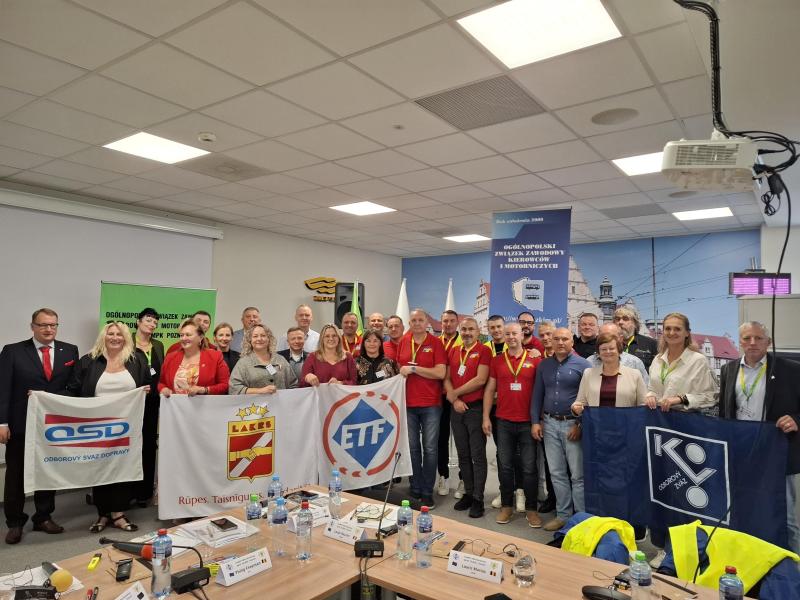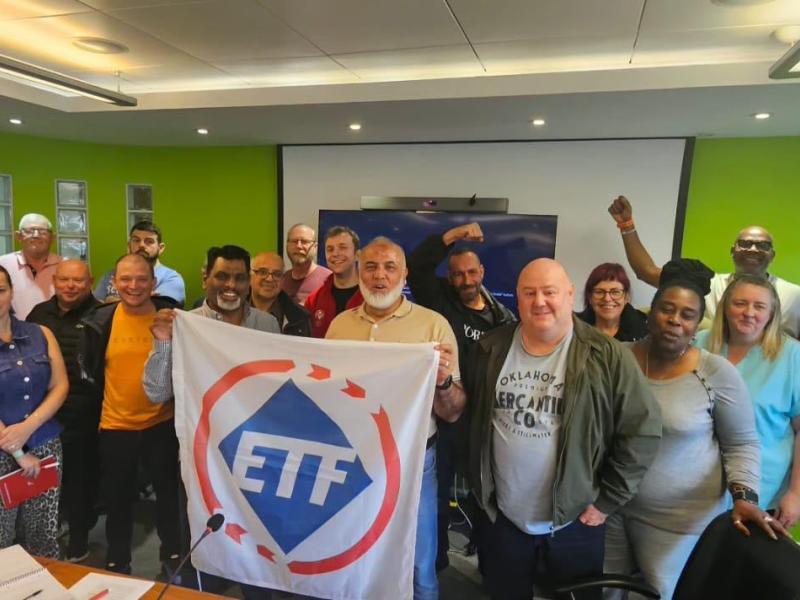


IndustriAll Europe and ETF joint workshop in Cologne discussed EU rail transport policies and rail development in Europe. Both organisations share concerns about constraints to achieve a Just Transition and the means currently available for rail workers, including the absence of a level playing field with other transport modes and insufficient investment.
To assess European rail transport policies and take stock of rail development in Europe, industriAll Europe and ETF organised a workshop in Cologne on 27- 28 June 2023 as part of a joint EU project, ‘Building a Just Transition towards a Smart and Sustainable Mobility’ (JT4 Mobility).
As part of its plan to become the first climate-neutral continent by 2050, the EU has committed to reducing transport emissions by 90%. Rail is by far the cleanest mode of transport and will play a central role in the decarbonisation of the European mobility system. Reaching that ambition will require much more than ad hoc communication initiatives like the Year of Rail.
A comprehensive and aggressive strategy is needed to boost the European rail industry. European trade union federations representing both manufacturing industry workers (industriAll Europe) and transport workers (European Transport Workers Federation – ETF) fully support the need to better support rail as part of an EU sustainable and inclusive mobility strategy but share concerns about the means currently available and the impact that existing EU transport policies have on rail.
A site visit of the ICE highspeed maintenance and repair workshop of Deutsche Bahn in Cologne-Nippes showed the cutting-edge digital technologies workers use but also revealed their struggle and the serious challenges workers face to keep the trains up and running on the tracks: time pressure, demanding safety requirements, high-tech operations needing high skills, in a context of ageing infrastructures, budget constraints and recruitment difficulties.
Currently, there is a lack of a level playing field with other transport modes and a lack of investment in infrastructure and rolling stock. Manufacturing companies are based in third countries that are not market economies, and there is a weak EU industrial strategy for the rail sector.
Trade unions raised a series of fundamental questions that the EU must tackle to ensure a Just Transition in the rail sector, such as social dumping, rail sector liberalisation, EU competition law undermining freight transport, the absence of an effective sectoral industrial strategy with strong social conditionalities, and the ability of the European rail industrial supply chain to design and manufacture the rolling stock and infrastructure at scale with the decarbonisation agenda.
Whereas digitalisation is gaining importance in the sector for manufacturing or rail equipment as well as for maintenance and operation of the rail system, it also entails challenges for the industry and its workers. The lack of skilled workers in part of the industry was a key issue, bringing to light possible solutions that include better working conditions, higher wages, re-skilling and up-skilling and improving diversity within the workforce.
IndustriAll Europe and the ETF both stress the need to:
- Develop a coherent and comprehensive strategy to boost the rail sector to preserve and create quality jobs in Europe, based on a dedicated European investment plan.
- Secure quality of employment across the rail system with good working conditions and high wages.
- Anticipate and negotiate measures to manage digitalisation, including training, re-skilling and up-skilling.