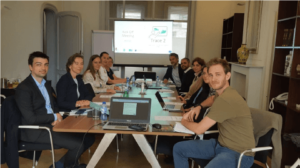
On the 5th of May in Brussels (Belgium), the TRACE 2 Consortium kicked off the project in a meeting hosted by the Coordinator CORTE (Confederation of Organisations in Road Transport Enforcement), in presence of all the partners – the European Transport Worker’s Federation (ETF), the International Road Transport Union (IRU) and SQUARIS Consultants. Representatives of the European Commission (DG Mobility and Transport), including Ewa Ptaszyńska (Deputy Head of Unit) were also present at the meeting.
The context
As part of Mobility Package I, a new set of rules for the road transport sector became applicable across the EU. The package is essential to ensure good implementation and enforcement of the road transport legislation, providing a balance between the social protection of drivers and the freedom of operators to provide cross-border transport services. To help the sector correctly apply these rules, the Commission services prepared a first set of guidance documents which will be gradually complemented by further guidance, where necessary.
Following the TRACE project – which focused on developing a common approach to the application of EU social and market rules in road transport and produced a simplified explanations and developed guidance on the application relevant regulations such as Regulation (EC) No 561/2006 and on Regulation (EU) No 165/2014 –, TRACE 2 will work during one year on the Efficient and harmonised enforcement of Mobility Package 1 across the EU.
TRACE 2 in a nutshell
TRACE 2 aims at developing content that can serve as a reliable common reference base for authorities and enforcers, as well as for drivers and transport undertakings. More specifically the project will:
• Develop a clear and shared understanding on the new rules introduced by the Mobility package 1.
• Identify enforcement related questions and develop a practical reliable enforcement guidance.
• Develop training and awareness raising material.
• Train control officers to foster a uniform enforcement approach.
• Widely disseminate the enforcement guidance/training material among all stakeholders in road transport domain.
TRACE 2 Plan of action
The Consortium will work on three topics impacted by Mobility Package 1: (i) Driving/resting times and provisions on tachographs, (ii) Lex Specialis on posting of drivers (iii) Access to the profession & haulage market.
First, a Data Collection and Analysis will (i) accumulate the discussions (till date) on the 3 topics listed above to understand how they have been impacted by Mobility Package 1, (ii) map the relevant court rulings, guidance notes and recommendations that have a bearing on road transport rules and (iii) investigate challenges faced by control officers and practices employed to overcome said challenges.
Second, the Development of enforcement guidance and training material will build upon the previous task to develop training curriculum and guidance documents/training materials. Finally, the Training of enforcers and dissemination of results will focus on delivering training and dissemination contents produced under the previous task, in particular through instructor-led and interactive training sessions for enforcers with a focus on practical implementation of enforcement guidance developed under the previous task, including realistic scenarios.
Stay tuned!
In the following trimester, TRACE 2 Consortium will (i) produce a short study detailing the changes introduced by Mobility Package 1, (ii) map the relevant court rulings, guidance notes, EC answers, recommendations, and best practices, and (iii) elaborate a curriculum.
You can already follow us on LinkedIn to make sure you don’t miss anything