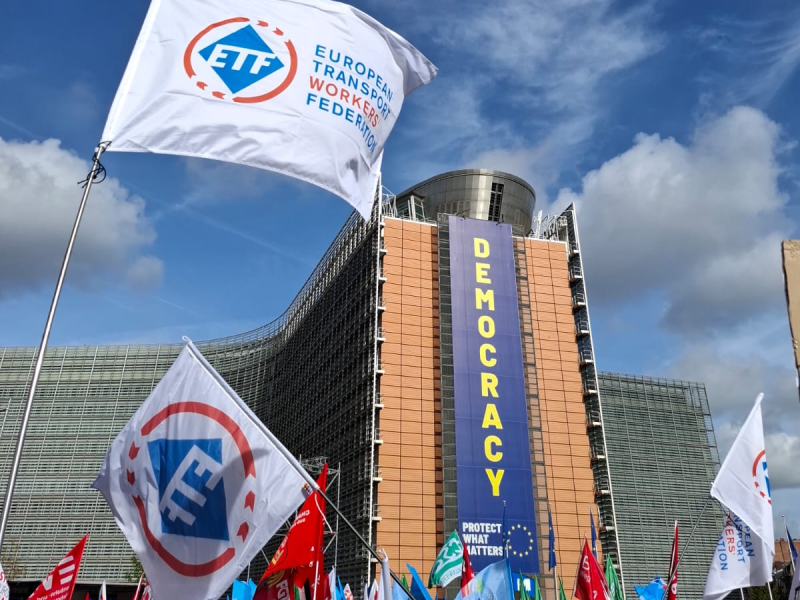
In early June, dockers in Europe took action by refusing to handle military cargo directed to the port of Haifa, Israel. Such actions highlight the growing urgency to end wars and uphold peace – and must not be criminalised. Lawful protests and the refusal to transport military equipment are legitimate expressions of conscience that deserve protection.
Across Europe, dockers and other transport workers are taking a stand against the movement of military equipment, asserting that ports and transport infrastructure should not be used to support armed conflict. These actions reflect a broader refusal to be complicit in violence and a shared belief in international solidarity and humanitarian values.
ETF reaffirms commitment to solidarity and justice
In the face of escalating global conflict, transport workers across Europe are showing extraordinary courage and conscience by taking action against the movement of military cargo. From ports to airports, workers are stepping up to defend humanitarian values – and the European Transport Workers’ Federation (ETF) stands firmly by their side.
“No one should be penalised for standing up against violence,” says ETF General Secretary Livia Spera. “We strongly oppose the criminalisation of transport workers, including dockers, who refuse to be complicit in war. Their courage must be defended, not repressed.”
What does this mean for the transport sector at large?
Throughout history, transport workers have borne the brunt of war. In every conflict, they are among the first to suffer – facing danger, disruption, and displacement.
Yet transport workers play a vital role in society, especially during crises. They are essential in facilitating humanitarian aid, evacuations, and the delivery of vital supplies. But in recent months, their role has gone beyond logistics, becoming a powerful voice for peace.
This has once again been made clear in the latest conflicts that have shaken our world. The refusal to participate in violence underlines a commendable determination of the working class to stand up against governments complicit in war.
Solidarity is not a crime
We strongly oppose the targeting of transport workers, including dockers, for standing up against violence and calling for peace. Workers who act in line with international solidarity and humanitarian principles must not be punished for doing so.
The ETF and its affiliates across Europe insist: the need for peace is urgent and non-negotiable. War must never be normalised. It is time to listen to the voices of workers, uphold human rights, and build a future rooted in justice, dignity, and peace.