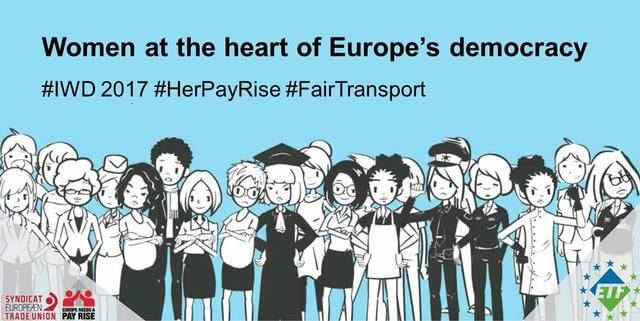
8 March 2017 marks the International Women’s Day and the European Trade Union Confederation (ETUC) calls for narrowing the gender pay gap and boosting the economy via its Pay rise campaign.
ETF supports ETUC’s call for a pay raise and in particular for women, which would narrow the gender pay gap, and boost the economy by giving millions of working women a decent income. This could be achieved by:
- Raising wages for cleaners, catering staff, carers, cashiers and clerks – jobs where the majority of workers are women. Women make up over 80% of the workforce workers in sectors such as personal care workers, cleaners and helpers, general and keyboard clerks, and health associate professionals;
- A flat rate increase in wages (as opposed to an undifferentiated % increase which maintains existing pay inequalities);
- Job evaluations: to review the grading of jobs mainly carried out by women and upgrade them to the pay of similar jobs mainly carried out by men;
- Pay transparency: where pay is not collectively bargained, pay increases are not transparent and men usually negotiate higher increases than women;
- Women joining a trade union: the wage gap among union members is less than half of the wage gap among non-union workers.
In the meantime the European Transport Workers’ Federation (ETF) is in full swing organising its Women’s Conference, to take place on 23 May 2017 in Barcelona. More than 100 union leaders and women transport workers from across Europe will gather together to take stock of past achievements and look into the future gender equality activities. The conference will also promote fair transport and fair working conditions, which will be the key element of the ETF Gender equality work programme for 2017-2022 entitled “Fair transport in Europe, fair jobs for women”.
“The ETF encourages women’s participation in the ETF Women’s Conference but also in the ETF 2017 Congress. We have been working assiduously for good women’s participation at all levels and we believe that a quarter of all participants will be women, largely exceeding the percentage of women working in the transport industry”, states Eduardo Chagas, ETF General Secretary
The ETF Women’s Conference will also set the scene for the presentation of the key findings of the ETF survey on workplace violence against women transport workers. During a 3-month period (25 November 2016 until 28 February 2017), more than 1,400 women transport workers shared their experiences on workplace violence. This evidence will be crucial for the development of the ETF policy to eliminate violence against women transport workers. The work will start as soon as the newly elected Women’s Committee takes up its work after the ETF Women’s Conference.