European Parliament calls for European Legislation to tackle Exploitative Subcontracting and Labour Intermediation
Brussels, 12 February 2026 – Today, the European Parliament adopted the EMPL Committee’s own-initiative report Addressing subcontracting chains and the role of intermediaries in order to protect workers’ rights, sending a clear political signal to the European Commission on the imperative need to propose an ambitious EU Directive on Subcontracting and Labour Intermediaries as part of the Quality Jobs Act.
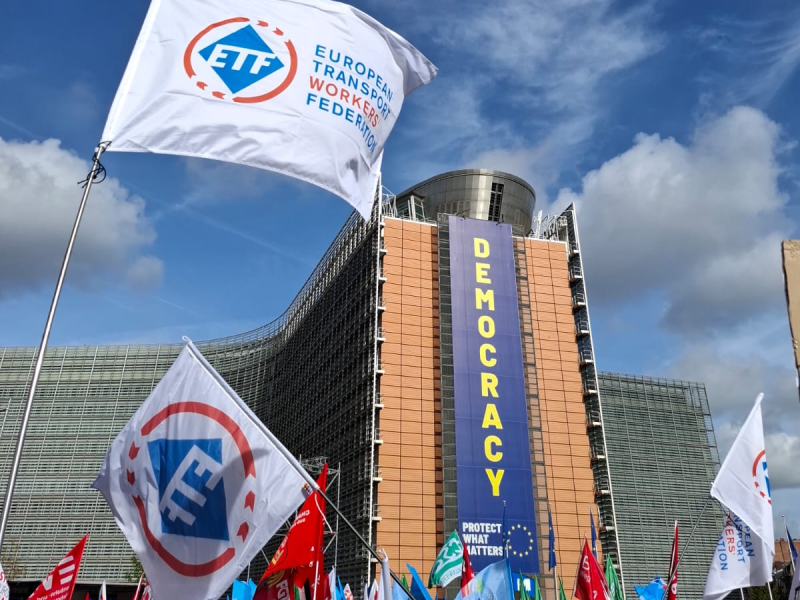
The vote follows this week’s powerful demonstration in Strasbourg, where hundreds of workers and trade unionists from EFBWW, EFFAT and ETF sectors stood in front of the European Parliament demanding an end to exploitation and the restoration of fairness across the EU labour market.
Representing millions of workers, sister Union Federations EFBWW, EFFAT and ETF welcome today’s vote as a decisive step towards tackling exploitation, social dumping and unfair competition that continues to plague construction, agriculture, food, tourism and transport sectors across Europe. This lays the groundwork to overcoming fragmented national rules and closing loopholes that allow exploitation and unfair competition to thrive, to the detriment of workers and compliant companies alike.
EFBWW, EFFAT and ETF welcome the Parliament’s strong support for key priorities, including:
- Limit contracting and subcontracting.
- Ban agencies and intermediaries in posting.
- Acknowledge of the risks linked to the contracting and subcontracting of core activities.
- Regulate labour intermediaries and tackle gangmaster practices.
- Strengthen enforcement with more and better inspections at EU and national level.
EFBWW General Secretary, Tom Deleu:
We did it. After years of campaigning and mobilizations of workers and trade unions the European Parliament adopted an ambitious report that calls on the Commission to present a Directive to limit subcontracting. This is an important step towards restoring fair competition and trust in the Internal Market. Many examples show that there is absolutely no reason for those long and untransparent chains of subcontracting that plague our sectors. They lead to fraud, social dumping and labour crime. We now call on the Commission to take appropriate action and come forward with a proposal for a Subcontracting Directive.
EFFAT General Secretary, Enrico Somaglia:
After years of tireless campaigning, the voices of working people outside the European Parliament have finally resonated within the plenary chamber in Strasbourg. Today’s vote represents a first ray of hope for the millions of workers in our sectors who endure exploitation, wage dumping and abuse daily. This plenary vote sends an unequivocal message: the Commission must now deliver an ambitious EU Directive on Subcontracting and Labour Intermediaries to restore equal treatment and fair competition across the EU labour market.
ETF General Secretary, Livia Spera:
MEPs understood that clear rules are needed to reinstate fairness in the labour market. Competition based on cutting labour costs and working conditions is a short-sighted strategy, harmful to workers and to those companies that respect the rules. Subcontracting is now on the EU political agenda and can’t be ignored. We have provided data, information and possible solutions. We have brought more than 800 workers in front of the EP, and their voices can’t be ignored. We now expect the European Commission to come forward with an ambitious proposal for an EU Directive.
The European Trade Union Confederation (ETUC) also welcomed the vote.
Esther Lynch, Secretary General, said:
This vote must spell the beginning of the end for the abuse of subcontracting chains and labour intermediation by fraudulent companies and, often, criminal gangs. The Commission must now urgently bring forward binding legislation, as part of the Quality Jobs Act, to end the abuse and exploitation of workers, caught in subcontracting chains and controlled by gang masters, once and for all
Ends
Media Contacts
- EFBWW Policy Officer | Teodora Ilieva | tilieva@efbww.eu
- EFFAT Communication Officer | Maddalena Colombi | m.colombi@effat.org | + 32 488 337 409
- ETF Communication Officer| Sarah Abou-Chleih | s.abouchleih@etf-europe.org |+32 495 24 60 03