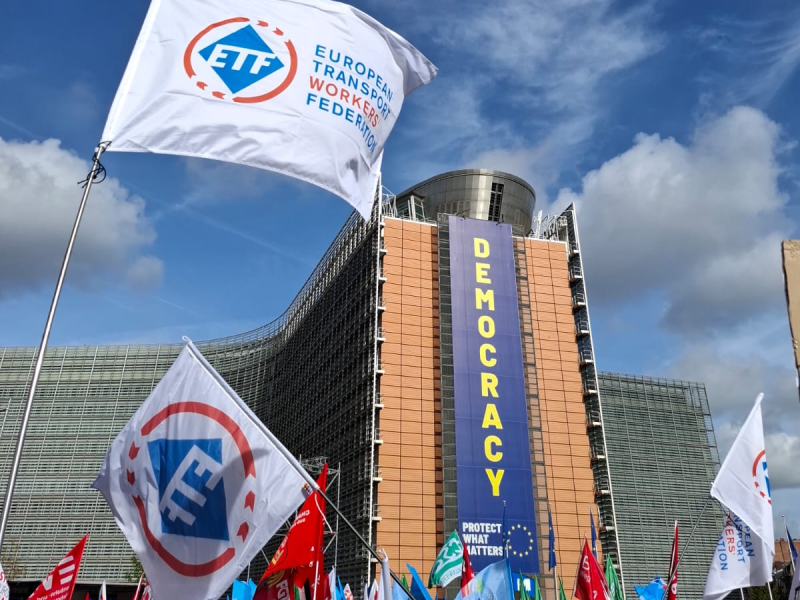
The European Transport Workers’ Federation (ETF) has written to EU Ministers and Ambassadors, urging them to address critical gaps in worker protection in the European Commission’s proposed Regulation on Military Transport, currently under discussion in the Council of the European Union.
In the letter, signed by General Secretary Livia Spera, ETF warns that the Commission’s proposal rests on a flawed assumption: that Europe’s transport systems can absorb additional pressure during crises without investment in the workforce that runs them.
Key Concerns Raised by the ETF
- Labour shortages cannot be ignored. Most European transport sectors are already struggling with severe staffing shortages, ageing workforces, and difficulties recruiting and retaining workers. The ETF stresses that long-term resilience demands real investment in transport jobs: pay, working conditions, and benefits.
- Proportionality in emergency powers. ETF calls for strict limits on the activation of the exceptional regime (EMERS/EMMERS), insisting it must be tied to an actual, periodically reviewed threat. Furthermore, collective industrial action carried out in accordance with national law must never be grounds for triggering EMERS.
- Road transport derogations go too far. The proposed changes to driving and rest time rules would allow drivers to work up to 12 weeks with only one 24-hour rest per week. These conditions are more demanding than those imposed during the Covid-19 pandemic, which drove tens of thousands of drivers out of the profession permanently. ETF rejects these changes as both disproportionate and dangerous to road safety.
- Negotiate emergency rules in advance. ETF argues that social acceptance and implementation of exceptional measures is best achieved through prior negotiation with social partners. Implementation and contingency plans should be developed at all relevant levels, including the workplace, and should address compensation, work organisation, and safety.
- Standards and vetting for military transport operators. ETF welcomes the proposed Military Transport Certificate but insists it must be conditional on high training standards and compliance records. Rail military transport should never be outsourced, and in road transport, a sector rife with fraud, only operators fully compliant with EU rules should be contracted.
- Protection for workers handling military cargo. Civilian workers engaged in military transport need dedicated training, and must not be held liable for theft, destruction, or sabotage of cargo by third parties. ETF calls on employers and contracting authorities to take full responsibility for incident prevention.
- Post-emergency recovery support. Companies and workers mobilised by the State during an emergency must receive compensation to remain financially viable. Workers laid off as a result of emergency-driven restructuring should be entitled to compensation.
- Aviation safety rules must not be changed by the back door. ETF warns that the proposed amendments to the EASA Basic Regulation go far beyond military mobility, introducing structural changes to the EU aviation safety framework without appropriate dedicated legislative scrutiny and stakeholder consultation.
A Call to Action
The ETF notes that several of these concerns are already being discussed in the TRAN and SEDE committees of the European Parliament, and urges Council members to act to correct the shortcomings in the Commission’s proposal.
The ETF urges Ministers and Ambassadors to take the Federation’s concerns seriously and to push for meaningful amendments to the Commission’s proposal in the Council’s General Approach.
Transport workers are not a variable to be adjusted in a crisis. They are the backbone of any credible military mobility strategy. Their rights, safety, and working conditions must be reflected in the final text of the regulation.
Read the full ETF position on the Military Mobility Package.