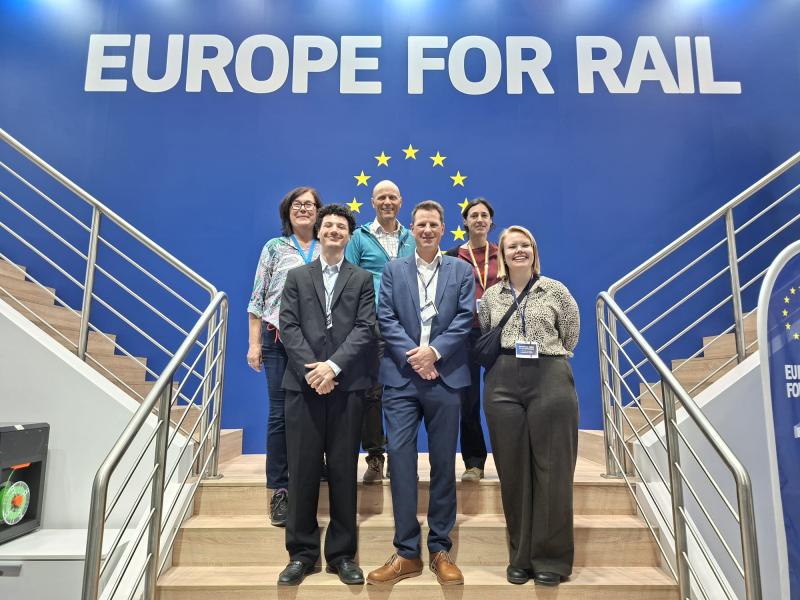
European Vice-President and Commissioner for Social Rights, Quality Jobs and Preparedness Roxana Mînzatu witnessed first-hand the harsh realities facing Europe’s truck drivers during a landmark visit to Belgian parking areas on Thursday with ETF and other road transport stakeholders.
Historic site visit sheds light on a crisis.
For the European Transport Workers’ Federation (ETF) and its affiliates, visiting parking areas has become an essential practice to listen to drivers and witness their working conditions first-hand.
In this regard, this Thursday, the ETF visited three parking areas in Belgium, alongside the European Commission’s Vice-President and Commissioner for Social Rights. The visit included a “Gold Certified” Safe and Secure Truck Parking Area (SSPA) and two non-certified parking areas.
The delegation also included representatives from the International Road Transport Union (IRU) and the European Secure Parking Organisation (ESPORG). ETF was represented by a delegation of four representatives, including the General Secretary, Livia Spera. ETF’s Belgian affiliates BTB/ABVV and ACV-Transcom also joined the delegation. Together, we brought the voice of drivers directly to the European Commission.
What the delegation witnessed reflects a broader crisis affecting the entire industry.
The crisis: a profession in exodus
One of the most urgent challenges facing European road transport today is the decline in job quality and wages for professional truck drivers. In recent years, many European truck drivers have been leaving the profession due to long periods away from home and the lack of adequate rest facilities. In response, drivers from third countries are being recruited under precarious conditions, many of whom face unsafe and unfair workplace standards, namely when it comes to resting.
The root causes are the lack of compliance with regulation and the lack of resting conditions
A fundamental yet often overlooked issue in the European road transport sector is the severe lack of parking spaces. Professional drivers frequently struggle to find even a basic spot to take their legally mandated 45-minute breaks. The situation is even more limited when it comes to Safe and Secure Truck Parking Areas (SSTPs), which take up a minimum amount of all parking areas in the EU, and are financially inaccessible for a large part of the industry.
According to an ETF study, over 60% of truck drivers and 66% of bus and coach drivers admitted to regularly driving while fatigued. One in four bus drivers and one in three truck drivers have fallen asleep behind the wheel. In too many cases, drivers were unable to stop and rest when they needed to.
The fact that there is too few parking areas in Europe may never be an excuse for employers to not comply with the quality or rest of their drivers. This common practice not only compromises their comfort and safety but also violates the intent of the EU’s Mobility Package, which mandates that drivers take their weekly rest periods outside the vehicle. ETF reaffirms that the mandatory rest period is an essential part of the employment conditions needed to maintain and attract new drivers, in addition to the improvement of the parking area offer.
Conclusion
Livia Spera, ETF General Secretary, stressed the importance of respecting the agreed rules in the EU: “In today’s visit, we once again stressed to the Commission that enforcement must improve, oversight must be stronger, and the rules of the Mobility Package must be fully upheld. Road operators need to tell drivers about their rights, make sure they take their weekly rest outside the cabin, and allow them to go home regularly, just as the Mobility Package requires.”
Commissioner Roxana Mînzatu added: “Safe and secure parking isn’t just a logistical issue – it’s about guaranteeing drivers’ dignity, safety, and respect. When we invest in better places for them to rest and work, we not only make the job more appealing and tackle labour shortages, but also strengthen road transport as the backbone of Europe’s economy”
The ETF calls on the European Commission to prioritise the expansion of safe and secure parking infrastructure and strengthen enforcement mechanisms to ensure drivers’ rights are protected across all member states.
Read more: