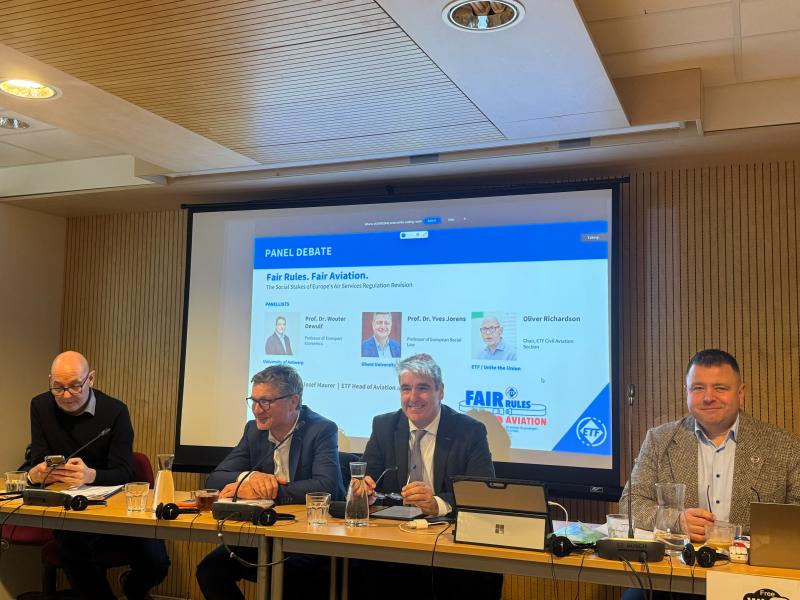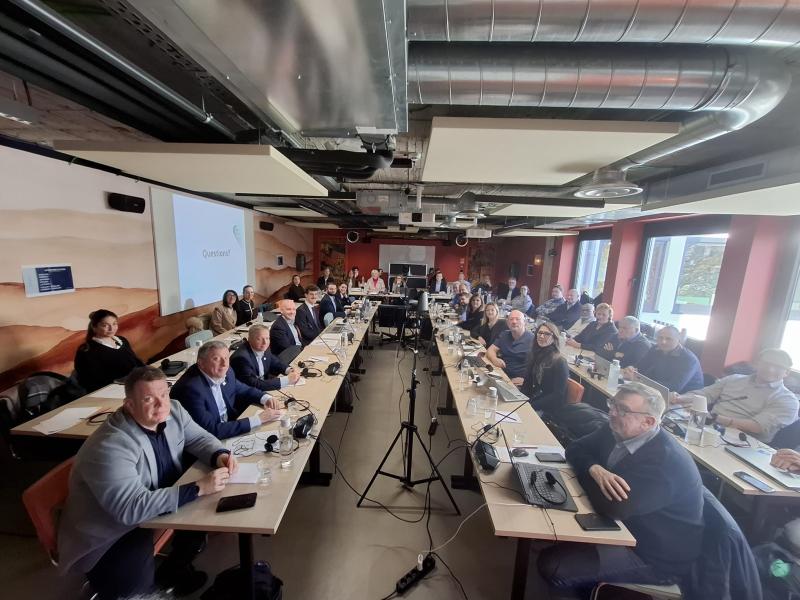

On 4 March 2026, the European Transport Workers’ Federation (ETF) Rail Section, along with Vida (Austria) and AK Europa, gathered key stakeholders at the Permanent Representation of Austria to the EU for a high-level lunch discussion on “Improving Rail Safety”. The event brought together a broad range of participants, including trade unionists, policy experts from the European Commission (DG MOVE), representatives of the European Parliament, and attachés. Our goal was to discuss a fundamental premise: rail safety is not a technical abstraction. It is directly linked to the working conditions of those who keep Europe moving.
A Call for Real-World Safety
Opening the discussion, Gerhard Tauchner, Chair of the ETF Railway Section, challenged the prevailing narrative surrounding international rail transport. “We need to finally look at the real problems in international rail and move past the myths regarding border crossings,” Tauchner stated. “Safety, social standards, and competitiveness are not separate goals. They are the pillars that make the sector attractive to workers”.
Tauchner highlighted two critical regulatory battlegrounds:
- Digital Monitoring: Ending 14-Hour Shifts: Despite living in a digital age, the rail sector lacks a tamper-proof, interoperable system for recording the working and rest times of onboard staff. Currently, authorities often rely on “self-disclosure” from railway companies, a system that fails to prevent shifts sometimes exceeding 14 hours. Tauchner welcomed the European Commission’s recent mandate to the European Union Agency for Railways (ERA) to develop a digital, fraud-proof recording method. This is viewed as a vital step toward genuine enforcement and the elimination of fatigue-related risks.
- Revision of the Train Drivers Directive (TDD): As the European Commission prepares to revise Directive 2007/59, the ETF seeks to be included in the discussion before the legislative draft is published. As a recognised European Social Partner, the ETF represents workers directly affected by regulations on training, certification, language and medical requirements. Tauchner noted that until operating systems across Europe are fully harmonised, maintaining high training standards remains a safety necessity.
The Big Picture: Cooperation Over Competition
The event also addressed the broader impact of the four Railway Packages and the political choices shaping the market. Jedde Hollewijn, ETF Senior Policy Officer for Railways, expanded on the “big picture,” noting that while rail remains the safest mode of land transport, this status is the result of decades of public investment and skilled labour, not coincidence.
Hollewijn warned that an increasing focus on intra-sectoral competition creates cost pressures and “perverse incentives”. When companies compete primarily on cost, staffing levels, training, and working hours are often the first areas squeezed. This shift toward “risk-based approaches” and self-regulation within the Safety Management Systems (SMS) of private undertakings has created vulnerabilities, often at the expense of workers’ and passengers’ safety.
“Any safety framework is only as strong as its capacity to enforce,” Hollewijn emphasised, raising concerns about the limited resources of National Safety Authorities and the ERA to monitor these systems effectively. Reflecting on lessons from the pandemic and infrastructure crises, the discussion highlighted that cooperation, not competition, is key to resilience.
Perspectives from Policy and Practice
The program featured technical insights from Marco Hörtenhuber-Stuhl (ETF’s ERA Coordinator) and Hervé Pineaud (Train Driver and TDD Expert). Joachim Lücking from DG MOVE contributed to the exchange with practitioners from the point of view of policymakers.
The consensus from the ETF’s perspective is clear: for Europe to achieve its Green Deal objectives, it must stop treating workers as obstacles to interoperability and start recognising them as the key safety resource they are. Safety must remain a public good and a prioritised investment, ensuring that those who operate the system are not driven to exhaustion in the name of a competitive variable.