

The aviation industry is a crucial component of Europe’s economy, employing millions across the continent. Collective bargaining agreements (CBAs) are vital in ensuring fair working conditions and wages for aviation workers.
Negotiating a CBA is not an easy exercise. From the level of pay to working conditions, shifts, resting time, entitlements of holiday, pay and conditions for sick leave, maternity leave, compensations for extra hours, seniority rights, occupational health and safety, specialised training, measures or sanctions in case of breaching the procedures – almost everything related to the specificities of the work in aviation can be part of CBA negotiations.
Such agreements require a lot of dynamics among the parties involved, with the ultimate goal of generating the best possible outcome for both sides: workers and employers.
On the unions’ side, negotiating a CBA is a complex exercise. At the end of this multi-faced process, the right balance between union members’ expectations and what the employer can offer must be found.
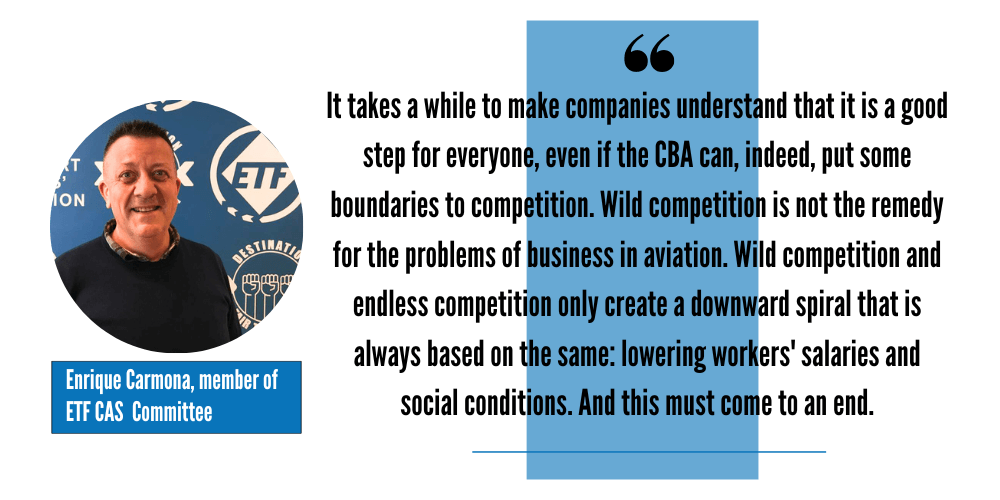
Enrique Carmona, member of the ETF CAS Committee and union leader representing the Spanish union CCOO, is straightforward: it may not be easy, but it is the only road to follow. In his opinion, without a CBA, the workers can only interact with the company from a perspective without boundaries:
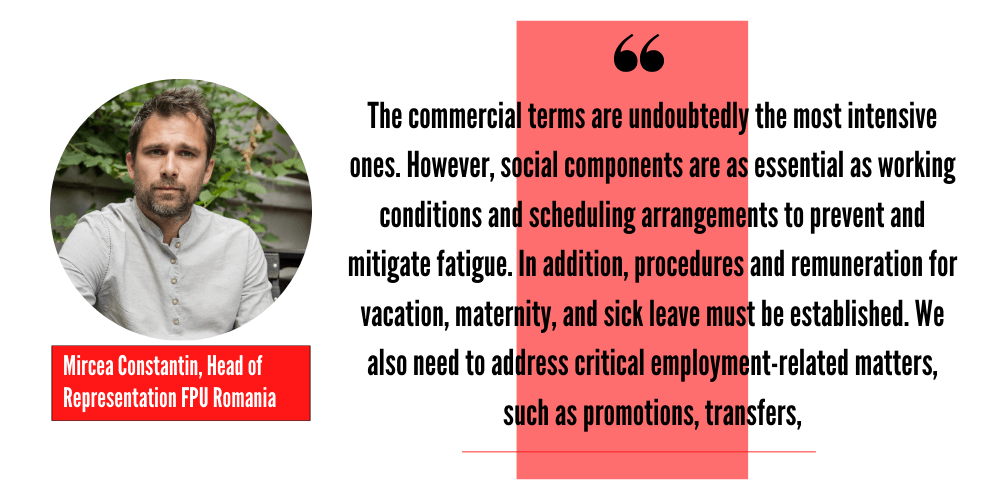
It has been intense work also for FPU Romania to convince employers to start negotiations. But they planned every step carefully, explains Mircea Constantin, Head of Representation FPU Romania, hoping to seal a deal. He is excited to be involved in the negotiation of their first labour agreement, and the discussions are just about to start:
Strong unions in the aviation industry in Poland are the key to negotiating decent collective bargaining agreements, states Maciej Kłosinski, Chairman of the Aviation Section of NSZZ “Solidarność”. There are real concerns in Poland, as most collective bargaining agreements covering air transport workers have been terminated or have not been concluded in recent years. Thus, the National Section of Air Transport Workers and Airport Workers NSZZ “Solidarność” are investing many efforts in supporting their affiliates to build a majority trade union.
In Maciej Kłosinski’s opinion, Chair of the Aviation Section of NSZZ “Solidarność” (Poland), the best solution for the industry is to conclude a collective labour agreement above the company level, which could cover employees and eventually regulate different forms of employment within the industry.
CBA negotiations have been a broadly accepted democratic and transparent exercise for many years in the Netherlands, as Walter van der Vlies, the president of the KLM Ground handling section at FNV, points out. After seven rounds of CBA negotiations with KLM, he believes the best outcome for workers was to secure fair pay, guaranteeing the same wage for the same position. Walter confesses that negotiations with employers may often go smoothly. Yet, the most challenging aspect is finding the right balance between workers’ demands while also keeping unity among members in case industrial action may be decided:
But throughout Europe, labour relations follow different rules. Surprisingly or not, employers in the UK can request negotiations with the unions around pay raises, working conditions, or even specific requirements for one sector within the aviation industry. Steve Jary, National Secretary of Aviation, Defence & Security at Prospect, remembers such a case in the ATM sector:
Functioning in a different legal framework, the UK unions constantly negotiate various parts of the labour contracts with companies. Yet, as Steve Jary points out, dealing with a union’s statutory recognition is the most challenging and even time-consuming process.
But what happens when negotiations fail? The most common reason CBA dialogue fails is the employer’s refusal to agree with workers’ demands. It happened recently in Germany, triggering warning strikes at regional and national levels, including in aviation. Our Ver.di aviation workers joined the end-of-March national warning strike. Thus, sending a clear signal that the requested salary increase to compensate for inflation is not negotiable.
‘Balance of power is the rule for successful negotiations’, considers Enrique Carmona. According to him, ‘trade unions’ force is given by the workers that stand behind; thus, the power of negotiation comes from the workers behind.’
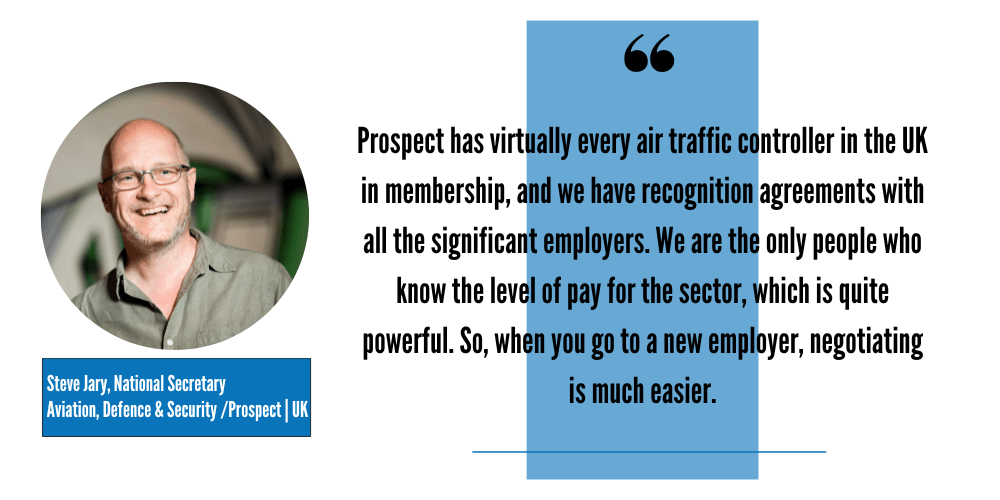
The power of a union is given by the number of its members, confirms Steve Jary:
Yet, union leaders are very cautious when asking workers to strike, especially considering the direct impact a strike in the sector has on transportation. Thus, it also risks turning public opinion against the workers protesting, even if they simply follow the rules of social dialogue in their attempt to secure their working rights via a CBA.
Time is always of the essence when negotiating collective bargaining agreements. It can take a few weeks or even half a year. However, the process can be smooth when both parties are engaged in good-faith negotiations. Signing the deal guarantees that workers’ rights will be respected while ensuring labour peace for employers.
CBAs are the only way to maintain a competitive, sustainable, and socially responsible European aviation sector.