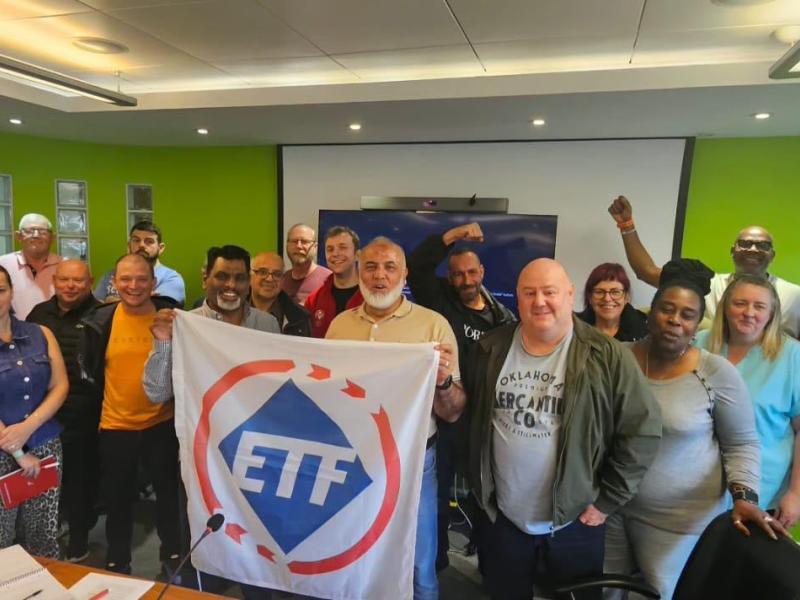
The European Transport Workers’ Federation held a special session at its 6th Congress to highlight the challenges and progress of trade unions working to organise workers in the nations of Central and Eastern Europe.
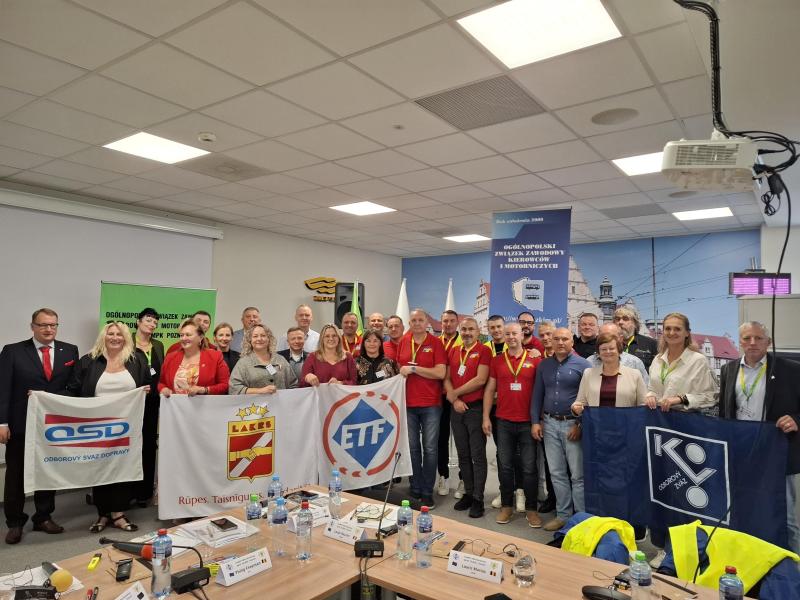
A roundtable chaired by Josef Maurer, Head of Operations, Central and Eastern Europe and Equalities, gathered representations from Bulgaria, Croatia, the Czech Republic, Estonia, Hungary, Latvia, Lithuania, Montenegro, Poland, Serbia, Slovakia and Slovenia at the Congress.
ETF put a lot of effort in the last five years, underlined Josef Maurer, and had undertaken important initiatives to put the federation ‘on the front foot’ in supporting unions and move the ETF towards being a significant political player in Central and Eastern European.
“With EU co-funded project ‘Moving the CEE transport unions forward,’ we had country visits to Hungary, Poland and recently also Turkey, and re-affiliations of unions from Poland and Turkey. We held a very successful Youth School; and with Croatian seafarers’ union, we are hoping to get the integration of their dockers currently fragmented unions,” said Josef Maurer.
Even though unions hadn’t been active since the fall of communism in Croatia, Neven Melvan, General Secretary of the Seafarers’ Union of Croatia (SPH), emphasised that unionism was introduced to many parts of the transport sector in this country thanks to some very active unions.
Yet, the language barrier remains one of the main challenges for connecting potential members to the European international union movement, believes Helena Svobodová from Czech Railway Workers’ Union (OSŽ). She gave the example of Czech railways workers who had to overcome a lower rate of English as a learned second language amongst its public railway members to share news and raise sentiments of solidarity.
Our affiliates in Turkey have additional challenges to organise workers and build workers’ power, as this often implies going up against the government. Kenan Öztürk from TÜMTİS explained how the union had a mixed experience with global logistics giant DHL:
“We had to support 35 workers dismissed by DHL just for being union members. We put up tents outside DHL’s offices. We fought for these members against this discrimination. We worked to get them reinstated. While we mostly have a good relationship now with DHL, it is true that we still have some issues with DHL Express, which is a different company. There is more work to be done.”
Rafał Tomaslak, director of COZZ Poland, spoke about their efforts to quietly build up union density in key airlines, in a geographically vast country of 40 million people, with huge air traffic growth potential:
“In recent years since the onset of Covid-19, there had been a “shift in the mindsets of the crew – a groundswell against the bogus self-employment model. I am feeling hopeful of change.”
In the final intervention of the panel, Adam Tylski from the Polish dockers’ union Solidarność presented the union’s success in organising the Baltic ports of northern Poland:
“We have built two successful campaigns to recruit dockworkers in the ports of Gdańsk and now Gdynia at different terminals. With ITF and ETF support, we are now embarking on our third terminal, where we already have one-third of the workforce signed up to the union.”
There is a straightforward conclusion to this debate: with governments that disrespect them and employers organising exploitation, our affiliates from Central and Eastern have to address many varied issues that transport workers face daily.
But we will continue to be there for them and fight together for our transport workers.
Organising our 6th Congress in Budapest is our way to thank our unions in Eastern and Central Europe, and a very big act of support to these courageous men and women trying to be independent trade unions.
As always, together, we are stronger!