On 31 January and 1 February, industriAll Europe and the European Transport Workers’ Federation (ETF) hosted the first set of workshops within their joint EU-funded project on Building a Just Transition towards a Smart and Sustainable Mobility.
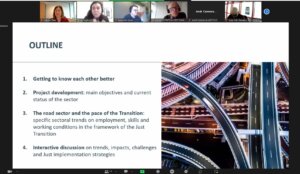
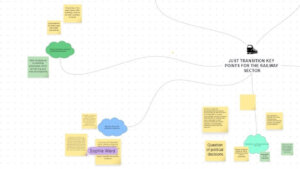
Each of the four workshops focused on one of the mobility subsectors: maritime, aviation, road transport and railways. Participants came together to identify and discuss common challenges and opportunities, and differences in the context of decarbonisation. They also looked at what a Just Transition would mean for both the vehicle and equipment manufacturing workers and transport service workers. The aim was to understand better the trends, impacts and challenges of the twin transition and propose strategies that could guarantee a fair and just transition for all workers.
Discussions focused on the impact of decarbonisation (and closely related digitalisation) on employment, skills and working conditions.
The challenges and opportunities are different for each subsector, with different prospects and trends for the different transport modes. For instance, there is a huge push at the EU level for a modal shift to the European railway sector and to encourage more freight and passenger transport by rail. This will directly impact employment in automotive and aircraft manufacturing and road and aviation transport services.
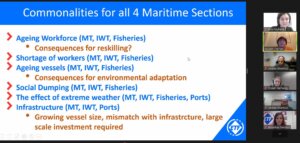
For some sectors, these policies and trends are not necessarily considered threatening. For example, in the road freight transport sector, serious staff shortages have resulted in a clear demand for better jobs in road transport, as the existing jobs are clearly not attractive to workers. The global health pandemic and the ongoing war in Ukraine also highlight the strategic importance of some sectors, such as maritime, which at the European level require more attention and investment to remain independent and competitive.
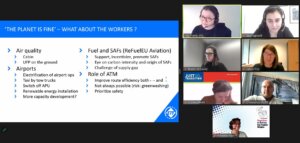
Yet, there are also many concerns and challenges that manufacturing and transport workers share. These include the ongoing automation and digitalisation and what this means for jobs and skills needs now and in the future, as well as their potential occupational health and safety risks for both groups of workers. Specific health and safety concerns and skills and training needs were also identified about introducing new fuels, such as hydrogen, in the aviation and maritime sectors.
Participants also pointed to various shortcomings in the implementation of decarbonisation strategies. In particular, they highlighted the lack of investment in critical infrastructure to support modal shifts and the uptake of sustainable fuels. The risks of the ongoing liberalisation of sectors such as railway and urban transport, to the detriment of working conditions and realising a truly Just Transition for workers, were underlined. A well-functioning social dialogue was identified as a key factor for the successful implementation of decarbonisation strategies.
“It is exactly the identification of these commonalities and differences that makes our joint project rich and promising, as it will contribute to a much stronger joint trade union strategy on Just Transition between manufacturing and transport workers”, explained Judith Kirton-Darling, Deputy General Secretary of industriAll Europe.
“Instead of focusing our debate on potential trade-offs between the different transport modes, and between manufacturing on the one hand and transport services on the other, our joint discussions will contribute to a mutual understanding of a Just Transition and build stronger trade union alliances.”
Sabine Trier, Deputy General Secretary of ETF, added:
“In order to achieve our ambition of making the mobility eco-system smart and sustainable, EU institutions must develop a comprehensive plan that ensures critical investments in infrastructure and technologies and that fights any attempts of social dumping and deteriorating working conditions”.
“We need a comprehensive Just Transition Framework that accompanies technological and modal shifts. Manufacturing and transport service workers are supporting a shift to smart and sustainable mobility that must be equally good for the environment and the workers.”
In the following months, industriAll Europe and ETF, with the support of Spin 360, will collect evidence and analyse the different trends, challenges and opportunities for each transport mode and identify concrete recommendations and best practices on how to achieve a Just Transition in the mobility ecosystem.