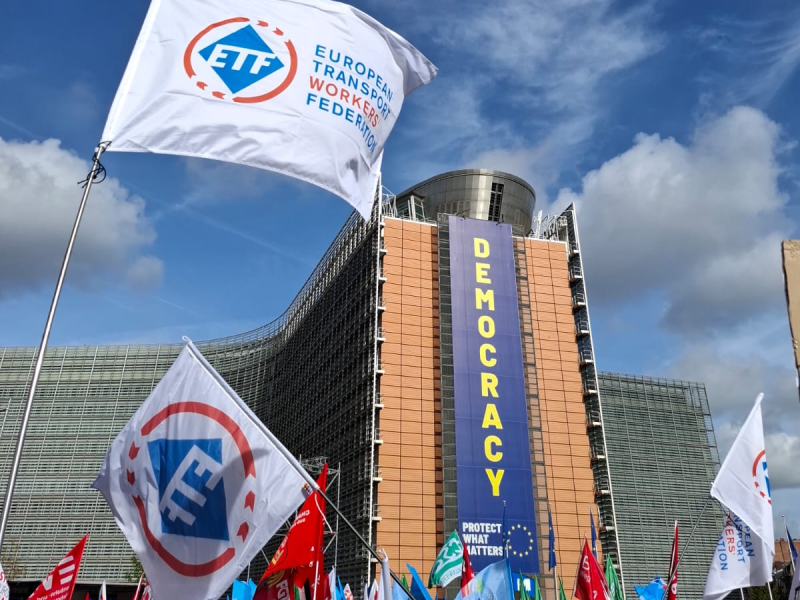
On World Public Transport Day, the ITF and ETF celebrate the vital role of workers, trade unions and passengers.
In every country, all around the world, public transport is the beating heart that keeps our cities moving – whether it’s the workers who sustain public transport or the passengers who depend on it, billions of people rely on this most vital of public services.
World Public Transport Day, an annual celebration of the social, environmental, and economic benefits of public transport – organised by the International Association of Public Transport (UITP) – exists to recognise this truth: that public transport is vital for our cities, and for our hopes of realising climate and economic justice.
“On World Public Transport Day, we celebrate everyone – from public transport workers to trade unions and passengers – who is committed to a social model of public transport based on climate and economic justice,” said International Transport Workers’ Federation (ITF) Urban Transport Chair, Eric Campos.
“But we also call for the investment in operations and infrastructure that we need and the crucial role of trade unions in ensuring that we can achieve this.”
Workers have always been at the heart of achieving sustainable, safe, efficient and accessible public transport.
It is the drivers, conductors, maintenance workers, ticket sellers, station staff, office workers and cleaners who keep our cities moving every day.
It is these workers who take pride in providing a public service which gets passengers to their jobs, schools, shops, families and recreation activities. And it is these workers who protect the health and safety of passengers, who are there in emergencies when people need them, and who are always on hand to help the elderly, the disabled and the vulnerable to access the public transport services they depend on.
“Alongside the passengers who need public transport every day, there are millions of public transport workers, both directly employed and sub-contracted, who depend on their jobs for their livelihoods – the workers who provide this high quality service need and deserve high quality jobs,” said Dirk Schlömer Chair of the European Transport Workers’ Federation (ETF) Urban Public Transport Committee.
“But to maintain public transport, we need investment. And there is no doubt that sustainable investment in expanding and improving public transport is an investment in our collective future.”
Without well trained public transport workers, the safety and efficiency of our public transport services is in jeopardy. That, in turn, threatens the realisation of economic and climate justice.
The ITF and the ETF are united in our demands for sustainable investment in public transport operations and infrastructure. It must include:
- Plans to address staffing shortfalls and recruit women and young workers
- Re-training for workers, including on the use of electric vehicles and other new technologies
- Improving pay and conditions to recruit and retain a skilled workforce
- Creating safe and gender-equal workplaces
- Incorporating informal public transport services into integrated, formal systems which guarantee secure and decent jobs
- Pushing for a modal shift that places mass public transport as the priority in urban transport systems to guarantee that everyone can have equal access to the city
In all of this, the role of trade unions must be paramount.
Trade unions give public transport workers a collective voice to defend and win their rights in their workplaces all around the world. Recognising and bargaining with trade unions, and involving them in decision-making from the outset, is critical to ensuring an understanding of and mutually beneficial collaboration with the public transport workforce. And by fighting for better working conditions, trade unions also play a critical role in employee retention for public transport companies
The ITF and the ETF deeply value their ongoing social dialogue relationship with UITP and its members to improve conditions for workers worldwide, and to ensure a just transition for the public transport workforce.
During Covid-19, UITP recognised public transport workers as the ‘Guardians of Mobility’ who kept essential services running despite the health risk to themselves. And now, just as during Covid-19, trade unions’ engagement with public transport authorities, companies and local and national governments everywhere must ensure that a social model of public transport keeps our cities moving, and that we move towards realising true economic and climate justice.