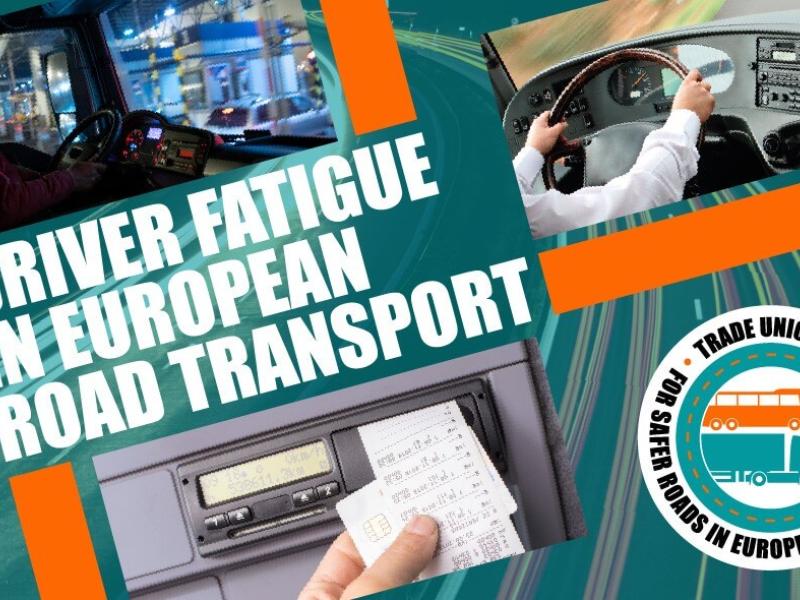


Road safety is one of the key priorities of the EU Institutions. For the past decade, the European Commission set the ambitious target to halve the number of road deaths but unfortunately progress made towards this goal has been slow. Keeping roads safe is largely dependent on the working and rest conditions of professional truck, bus and coach drivers.

Today, the driver’s profession is more stressful and dangerous than it once was. Roads are busier, schedules are tighter, less time for rest and longer hours on the road. Fatigue makes it harder for them to maintain vigilance, alertness and decision-making capacity in traffic, and this impairs their ability to drive freight and passengers safely to their destination.
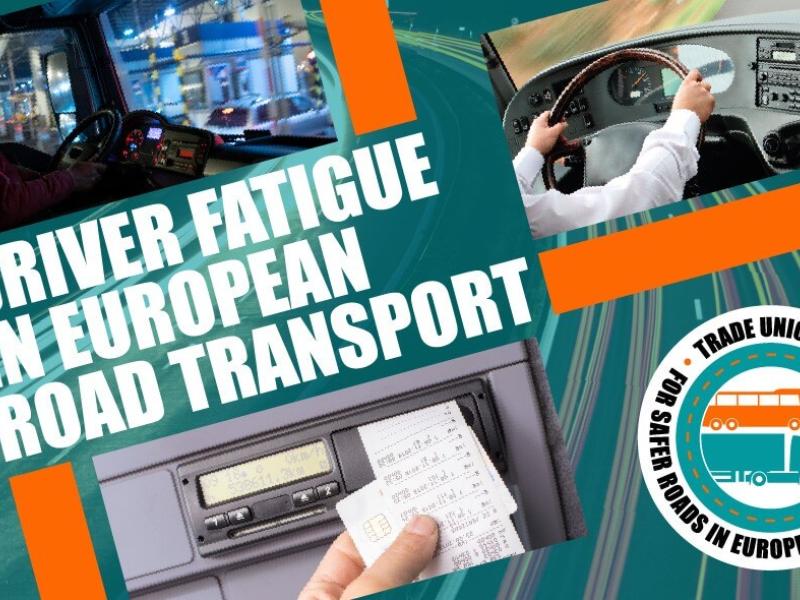
ETF’s study, the first EU-wide study in 15 years, on driver fatigue in passenger and road freight transport revealed fatigue in professional drivers is the norm on European roads and directly linked to their notoriously poor working conditions.
2861 truck, bus and coach drivers in freight and passenger road transport gave the ETF direct insight into their harsh reality:
- 60% of truck drivers and 66% of bus and coach drivers said they had to drive while fatigued on a regular basis
- 772 drivers said they nearly crashed and caused a major road accident due to driver fatigue
- Nearly 1/3 of truck drivers and 1/4 of coach drivers reported falling asleep at the wheel while driving
- 57% of bus and coach drivers and 52% of truck drivers reported wanting to pull over and take a break when feeling tired but being unable to
Fatigue is never the driver’s fault: poor working conditions create fatigue:
Long hours for low wages, unpredictable working time, virtually no real breaks, bad sleep and rest facilities, inadequately equipped vehicles, all while slaloming buses full of passengers and trucks filled to the brim with goods through heavy traffic.
All this adds up to driver fatigue, endangering the safety of drivers and other road users, increasing the risk of accidents on EU roads.
While it is a well-known fact that driver fatigue poses a major risk to the road safety of all road users, measures taken among employers and at the European policy and legislative level to tackle this issue for professional drivers are insufficient.
Eliminating driver fatigue is becoming even more urgent by the minute, especially as the EU embarks on its Road Safety Policy Framework 2021-2030 – Next steps towards ‘Vision Zero’.
In the face of inaction, the ETF is raising the issue of driver fatigue, its impact on road safety and the effective enforcement of the Mobility Package and calling for action from policy makers and employers:
- to guarantee fair wages – current extremely low wages force drivers to work longer hours to make a decent living
- to ensure that drivers are remunerated for all work-related tasks, which is not always the case
- to stop plans to make driving and rest time rules more flexible in freight and passenger transport
- to put eliminating driver fatigue at the core of the EU road safety strategies
- to ensure that professional drivers’ pay, working time and rest conditions are properly enforced
- to ensure that derogations from rules are done by the book, and not to permanently extend drivers’ hours, keep them away from home and worsen rest conditions.
The ETF is also recommending a range of other measures to increase drivers’ well-being and road safety overall.
Europe has no time to lose. Given that road accidents involving heavy vehicles tend to be more serious than other collisions, because of the sheer size and mass of the vehicles, further delay will throw a spanner in the works and be detrimental to achieving “Vision Zero” and result in fatal consequences for road safety.
Resources
Study Background
In January 2020, in cooperation with EVA Akademie, the ETF started an eighteen-month EU-funded project. The purpose of the project is to build capacity among the ETF member organisations to address driver fatigue in passenger and freight transport, with their members, with policy-makers, and companies.
The German research institute wmp consult worked with the ETF to develop a fatigue study in bus, coach and haulage transport. The methodology included extensive desk research, a survey covering over 2600 respondents, and targeted interviews with academics, drivers and union representatives. The project funded three workshops, with the participation of road inspectorates, experts in occupational fatigue and road safety.
Empowering the ETF and trade unions to raise awareness on driver fatigue is now crucial, the key outcomes of this project can be downloaded at your right.
For further information about the project and its activities, please contact the ETF Secretariat at road@etf-europe.org and our project partner EVA Akademie at almut.spittel@eva-akademie.de.
With financial support from the European Union

European Truck Driver Shortage: only way forward is good pay and conditions!

European Commission’s plans to relax passenger transport driving and rest time rules put road safety at risk

UK measure to extend driving time will contribute to driver shortage
ETF study on driver fatigue hits the mark

ETF and ETSC vow to make road safety a reality